Hosting note
Company Anniversary Games from Stories You Already Tell
The cake is for a number. Five years, ten, the slightly awkward seven. Someone has been asked to say what the company means, and the room can already hear the speech getting longer than the cake. A company anniversary game is a way to spend the middle of that hour on stories the team already tells, on one screen, with a finish. It is not a second all-hands. It is not a reel of logos. It is sixteen clues, and then you sit down.
Four categories, four clues each, 100 through 400. The board is on a screen the room can read. Phones are the buzzers. You read, you open the buzz, you judge, the score stays up. People join with a six-digit code in the browser. No app and no account. An anniversary invite often includes people who do not have a company login, and should not need one to eat cake.
A December party with a harder exit is office holiday party games that end on time. A birthday for a person, not a company, is birthday party trivia the guest of honor can stand. An anniversary is the year, or the years, this particular group can stand to hear out loud.
The stories that are already public
Write the answer first. The city of the first office, if people still point at it. The product name you retired, if the retirement was a party and not a wound. The offsite where the photo on the wall was taken. The snack that has survived every office move. A 100 should be easy for more than the founders. If the first clue can only be answered by the two people who were in the garage, you have written a speech with a buzzer, and the people who joined last year will check out.
Ask three people who were not founders what they would put on the board. You will get better clues than the official timeline. The official timeline is usually a list of rounds and launches. The room remembers the broken door, the name of the dog, the release that slipped, the lunch that became a tradition. Use the ones they laugh at. Leave the ones that still have a person attached who is not laughing.
Leave the cap table out. Leave the people who were let go, unless the room has a kind version and the people themselves would not mind being a 200, which is a high bar and usually means you should skip it. Leave the client you cannot name. An anniversary screen is a bad place for a fact that is only true inside a private channel. If you would not put it on a slide the whole company sees, it is not a clue.
Four columns. One for the early days, short, so it does not become a sermon. One for the year you just had, which the newest people can play. One for the place and the habits: the mug, the meeting, the phrase the team overuses. One that is easy on purpose, so a table of families or clients who were invited to the party can score without having worked the year. Values climb. The 400 in the early-days column can be a detail one person remembers, on purpose, so they get a moment. It should still be a detail the room is glad to hear.
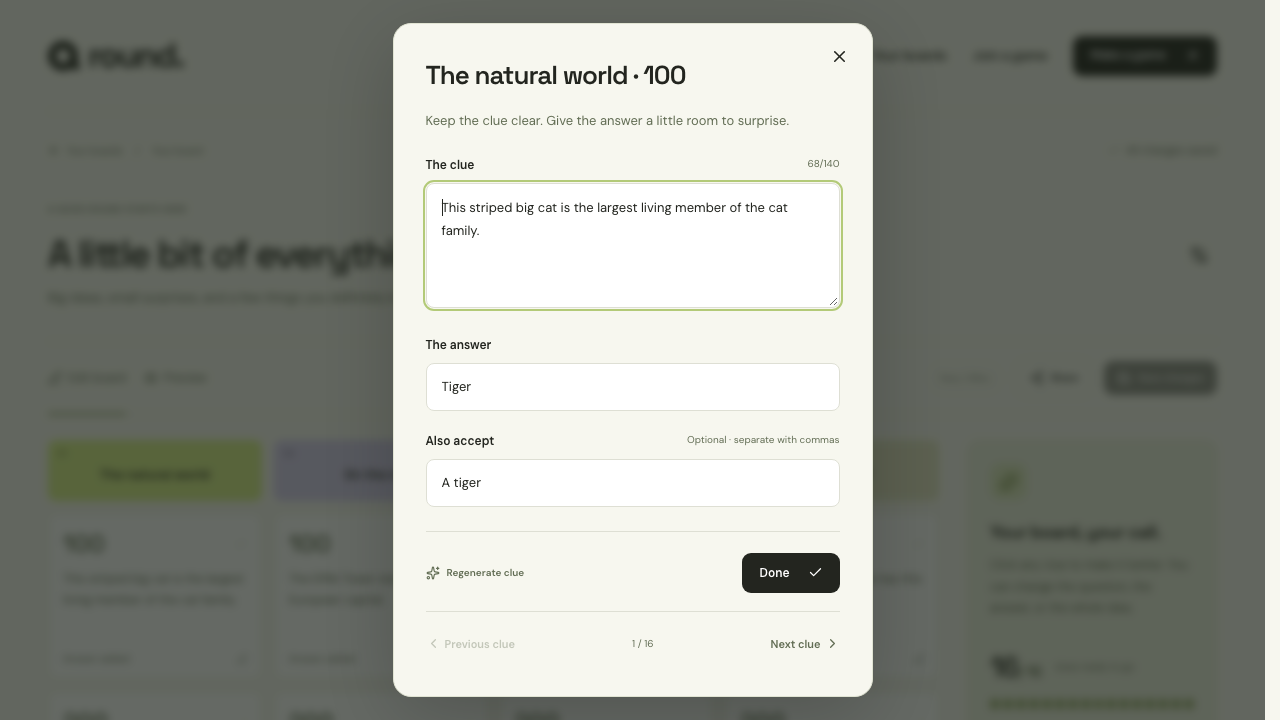
Put the other wording on the card. The old product name and the new one. The neighborhood and the street. You will hear both, and an anniversary is a silly time to argue about which is official.
How long the cake will wait
A full board is about twenty-five to thirty-five minutes once buzzing makes sense. That is the gap between the welcome and the cake if someone is disciplined, and it is too long if there are also awards. If there are awards, play eight clues or play none. Two ceremonies in one hour is how people start looking at the door during both of them.
Teams before the grid. Three or four people. Mix the old and the new on purpose, so the early-days column has a translator and the this-year column has a witness. One phone per team. Do not make “founders” a team against “everyone else” unless that is a joke the everyone-else table actually likes, and even then, look at it twice.
Free covers 20 people and 6 teams. Night is $12 for 48 hours and 100 people. Host is $6 a month, or $48 for the year, and covers 100 people in a game. The team cap stays at 6 after you pay. Players never pay. An anniversary that invited the whole company and their families is larger than one buzzer game. Play the tables that can see the screen. Let the back of the room keep talking. A game nobody can read will make the front tables look like they are performing. The numbers are on the pricing page.
The code stays up while people find a seat. Guest Wi-Fi gets said once, or people use their own data. You should not be the person debugging a portal while the cake sits.
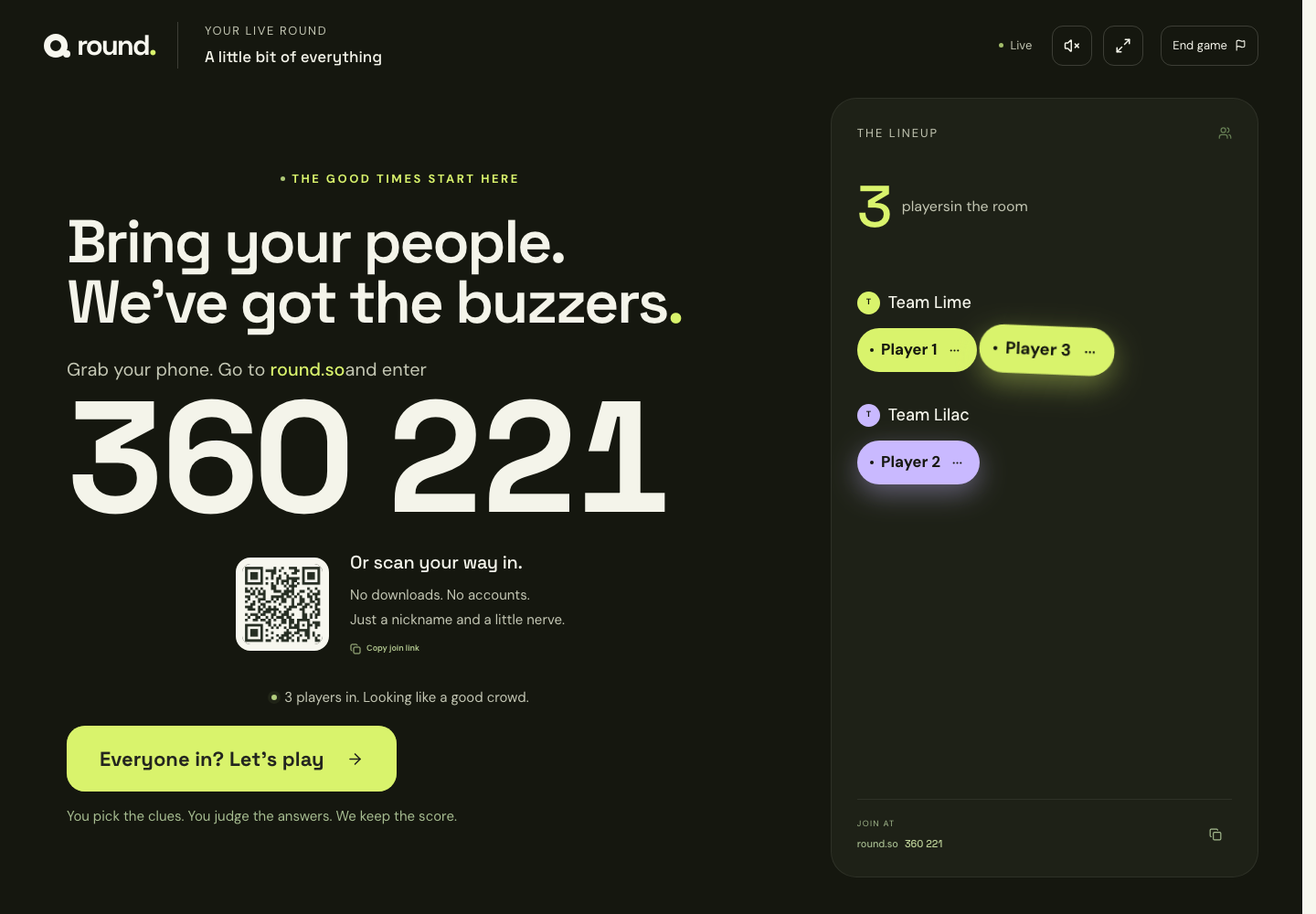
Teams land here. The names can be silly. Read them once, and change any name you would not put on the invitation.
Rules for a room that includes someone’s family
You read the clue with buzzing closed, then you open it. An early press waits a quarter of a second. Say that once. Someone’s partner will mash the button because they are having fun, and the lockout will explain it better than you can.
Eight seconds after a clean buzz. You judge. The clock does not mark the answer wrong while you are still listening. Party scoring takes the tile’s value off for a miss. At an anniversary, with families in the room, keep the 100s soft so that sting is rare. Do not switch the rule when the founders are losing. If children are buzzing, pick Kids before you start, so a miss scores nothing and the score cannot fall below zero. That choice also uses the classroom colors. For a room of adults, stay on Office or Friends and family and write a kind top row.
Ten seconds of silence and the answer shows. Do not coax. After a right answer, that team picks the next tile. If the founders’ table is sweeping the early-days column, hand a pick to a table that joined later. One sentence. “Your pick.” The year column is over there.
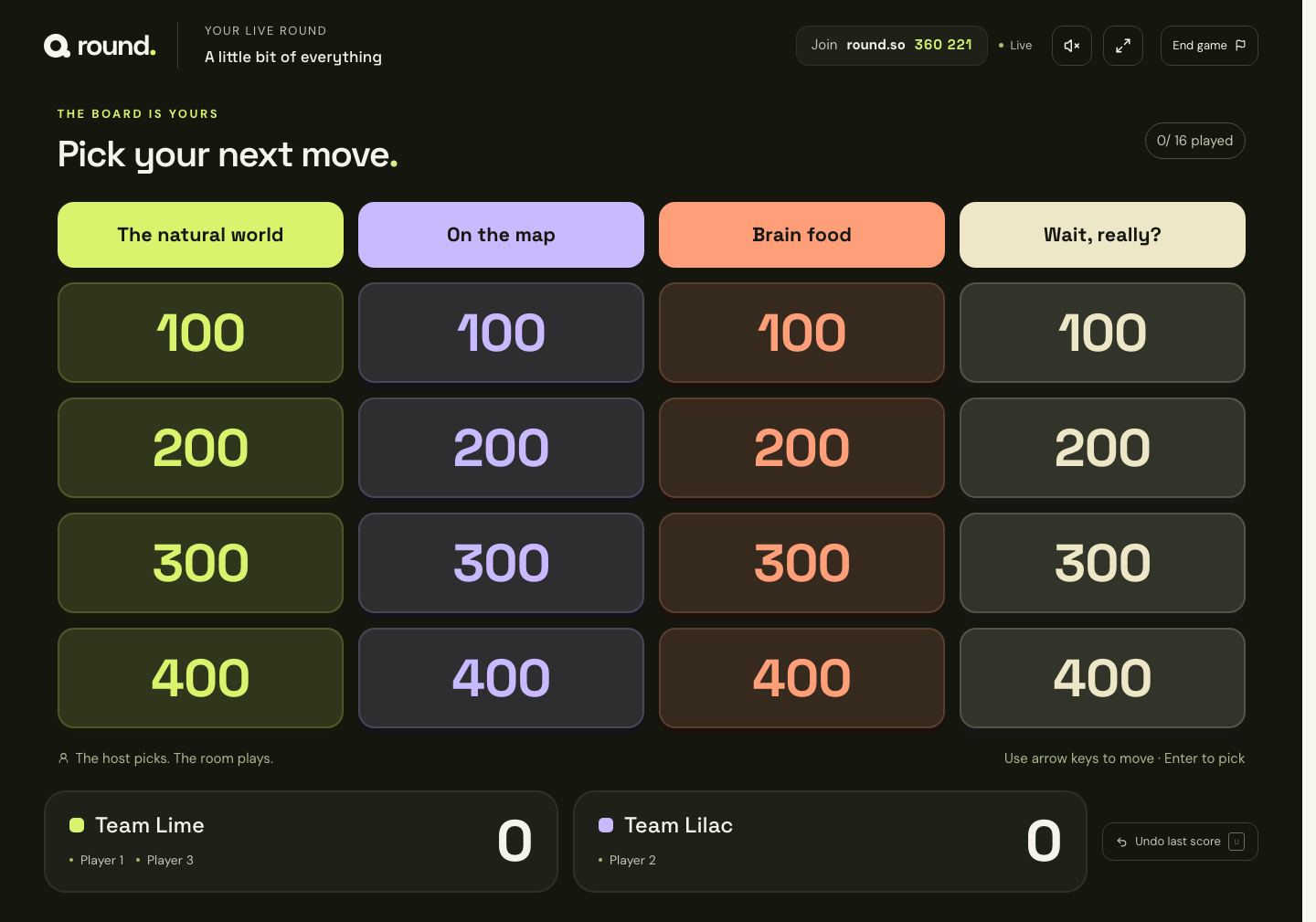
You run this screen. Their phones only buzz. The score under the board is what you will say at the end, and then you will not frame it.
The speech and the game are different jobs
If you are also giving the toast, do not do both in the same ten minutes. The toast is a paragraph. The game is a board you already checked. Give the toast, sit down, and let someone else advance the tiles if you are the person who might get lost in the story. You can still say whether an answer counted.
Do not let the game become the only record of the company. A clue is one sentence. It will flatten a year, and that is fine, because it is a game. It is not fine if the clue is the only time a team’s work is mentioned, and the mention is a joke they did not agree to. Ask. “Can this be a 200?” is a one-line message, and it saves you from a table that goes quiet for a reason you will only understand later.
People who left and people who stayed can both be in the room. Write for the people who came. A clue that scores a point by excluding half the tables is a bad anniversary, even if it is accurate. The easy column is how a partner, a parent, or a new hire stays in the hour. Use it. Do not apologize for it.
Prizes stay small. Name a winner because people will ask. The extra piece of cake, bragging rights until Monday, nothing with a number on it. A valuable prize makes a family hear a close call as a verdict about who belongs. You already have enough of those conversations. This one can be cheap.
Stop before the thank-yous get long
End when the board you promised is done, or when the cake is ready, whichever you said. Read the score. Thank the teams by names you can say in front of clients, if clients are there. Close the laptop before the next speaker, so the screen is not a second presenter.
If part of the company is on a video call, one person shares the host screen and the remote tables keep their own phones. They still need the six-digit code, and they still count toward the room size. A tile nobody on the call can read is not a clue for them. Make the type large enough for a laptop window, or accept that the game is for the room you are standing in and say so. Do not run two games at once. One board, one host, one score.
If you take a photo of the board, take it of the room, not of a ranking you will post as if it were a result. An anniversary score is a game. Next year’s board should not start from the winners list.
If the network fails, first hand up, eight seconds, same answers. Then stop. An anniversary does not get a technical intermission. The cake is the point you can still keep.
Questions people ask while the cake is on order
How long should a company anniversary game be?
Eight clues if there are speeches. Sixteen if the game is the program and the screen is ready. Say the minutes in the invite. A second board is next year’s problem, unless the room refuses to let you turn it off, which is a good sign and still a choice.
Can clients play?
Yes, if the clues are ones you would say with them in the room, because they are in the room. Keep a column they can answer. Skip the internal jokes that require a preface. If a clue needs a preface, it is a story for later, with fewer people.
What if the founders know every answer?
Give them one column. Build the other three for the people who do the work now. If they shout before a buzz, ignore it once, kindly, and open the buzz for real. The room will understand. The founders will survive.
Does everyone need an account?
No. A browser and the code. One phone per team. Partners and parents do not need a company login, and you should not ask them for one.
The week you still have a quiet hour
Write the clues from the stories people already tell, not from the about page. Read them once. Cut any sentence that only works if you explain who was wrong. Get the cable to the room before the guests do.
You can start from the company anniversary boards, or build this year’s board on the create page. Pick Office for a room of colleagues. Pick Friends and family if the tables are mixed with the people they went home to. Either way a miss costs the tile, so the 100s stay easy. Keep the board. Next year’s number should not mean starting from a blank page and a panic.
If the sentences are the hard part, trivia night questions you can read out loud is about writing a clue in one breath. An anniversary clue has one job: to be true, kind, and over before the cake.
Host a company anniversary round
One screen, sixteen clues, phones as the buzzers. The company anniversary boards are already written, or start from a blank grid.
Make a company anniversary game