Hosting note
Trivia Night Questions You Can Read Out Loud
The list you found has a hundred questions, and number four wants a treaty, a year, and a country, in that order. You are supposed to read it while people are eating. They will hear the first noun, buzz, and then argue about which half you were asking. That list was written to be looked at on a phone at a red light. Trivia night questions have a harder job. They have to survive one reading, in a room with a fan or a playlist or a child, and still have an answer you can judge in a second.
A question you can host is a short sentence with the answer taken out. The answer is a name, a number, or a phrase you are willing to accept in more than one wording. You already know the answer before you write the sentence. If you cannot say the sentence in one breath, it is not ready, no matter how proud you are of the fact.
Sixteen of those, in four categories, is a round. A hundred of them is a document. You will host the round.
Write the answer before the sentence
This sounds backward until you try it the other way. If you start with the sentence, you smuggle the answer into it, or you write a paragraph that shows how much you know. Start with "Andorra." Then ask what a room can be told that points there and does not say the name. "This landlocked country sits between France and Spain in the Pyrenees." That is a 400, and it should be, because most tables will need a second to see it. "Paris" is a 100 if the sentence is "The Eiffel Tower stands in this European capital," and it is a worse 100 if you add three more clauses about the river.
The answer has to fit in a few words. Around sixty characters is a practical ceiling, because you are judging while people watch your face. "The control group" fits. "The group of plants that did not receive the experimental treatment of light, which we used as a baseline" does not fit, and it is also the explanation, which you can say after you reveal, in one sentence, if the room missed it.
Then write the other wordings you will take. Tiger and "a tiger." Honeybees and "bees." Stomata and "stoma." Decide this the night before, not when a team is halfway through a justification. If you would accept the nickname and the proper name, put both on the card. If you would not accept "the powerhouse of the cell" when you asked for mitochondria, do not discover your standards live. Your standards are whatever you wrote down, and the room is calmer when that is obvious.
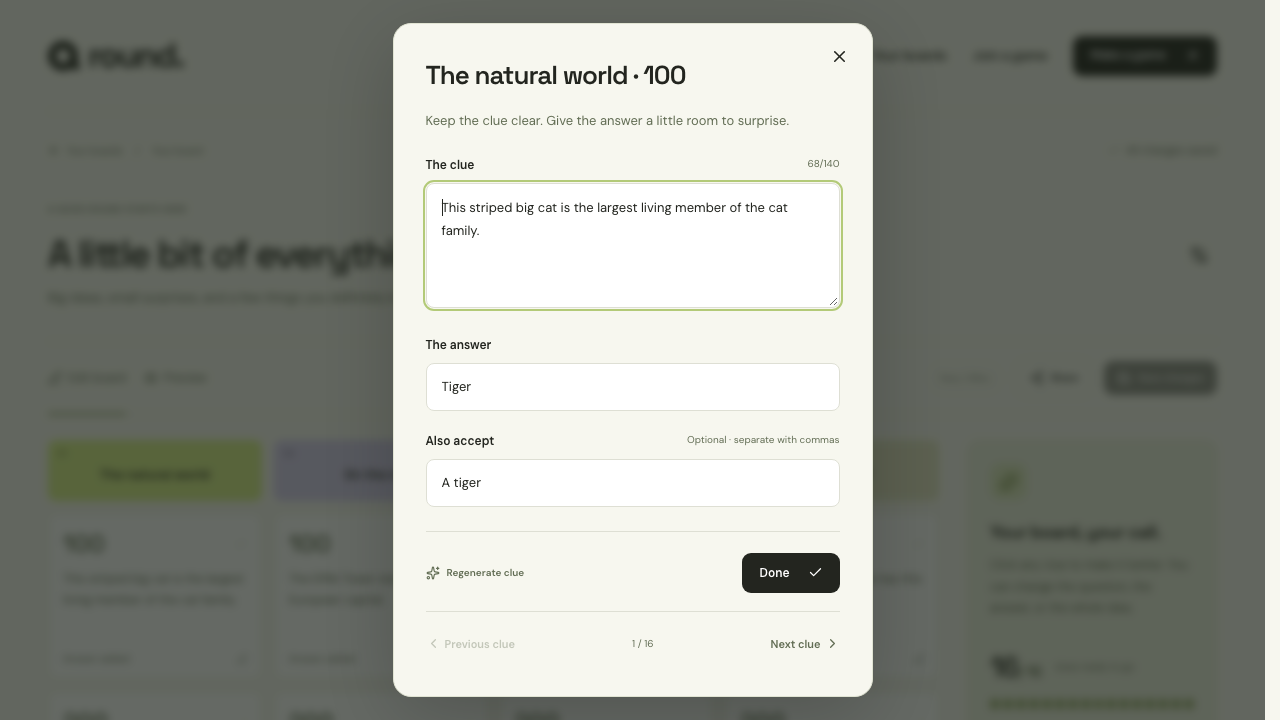
The little count in the corner is doing you a favor. If the sentence is crowding the limit, the second line is usually a warm-up you can cut. The fact can stand on its own.
A column that gets harder on purpose
Points and difficulty have to move together, or your sharpest table will skip the top row and your kindest table will never get a win. Here is a whole category, the kind you can put on a board tonight, with the climb built in.
100. This striped big cat is the largest living member of the cat family. Tiger. Also take "a tiger."
200. These insects communicate the location of food by performing a waggle dance. Honeybees. Also take "bees."
300. Most of a plant's water escapes through tiny pores with this name. Stomata. Also take "stoma."
400. This marine animal has three hearts and blue blood. Octopus.
Somebody in the room gets the 100 without thinking, which is what you want. The 200 is a fact they half-remember from a video. The 300 asks for a word they may have met once. The 400 is a weird true thing, and if they miss it, "three hearts, blue blood" is a good enough reveal that the miss feels like a gift. You do not need every 400 to humiliate. You need it to be clearly harder than the 100 above it.
A second column, so you can see the same climb in a different subject:
100. The Eiffel Tower stands in this European capital. Paris.
200. This country is home to the cities of Kyoto and Osaka. Japan.
300. This is the only continent with no permanent human residents. Antarctica.
400. This landlocked country sits between France and Spain in the Pyrenees. Andorra.
Read both columns out loud before you save them. The Kyoto sentence is almost too packed, and it still works because the two city names do the pointing and the answer is one word. If you added "which is also famous for..." you would be writing for a page, not for a mouth.
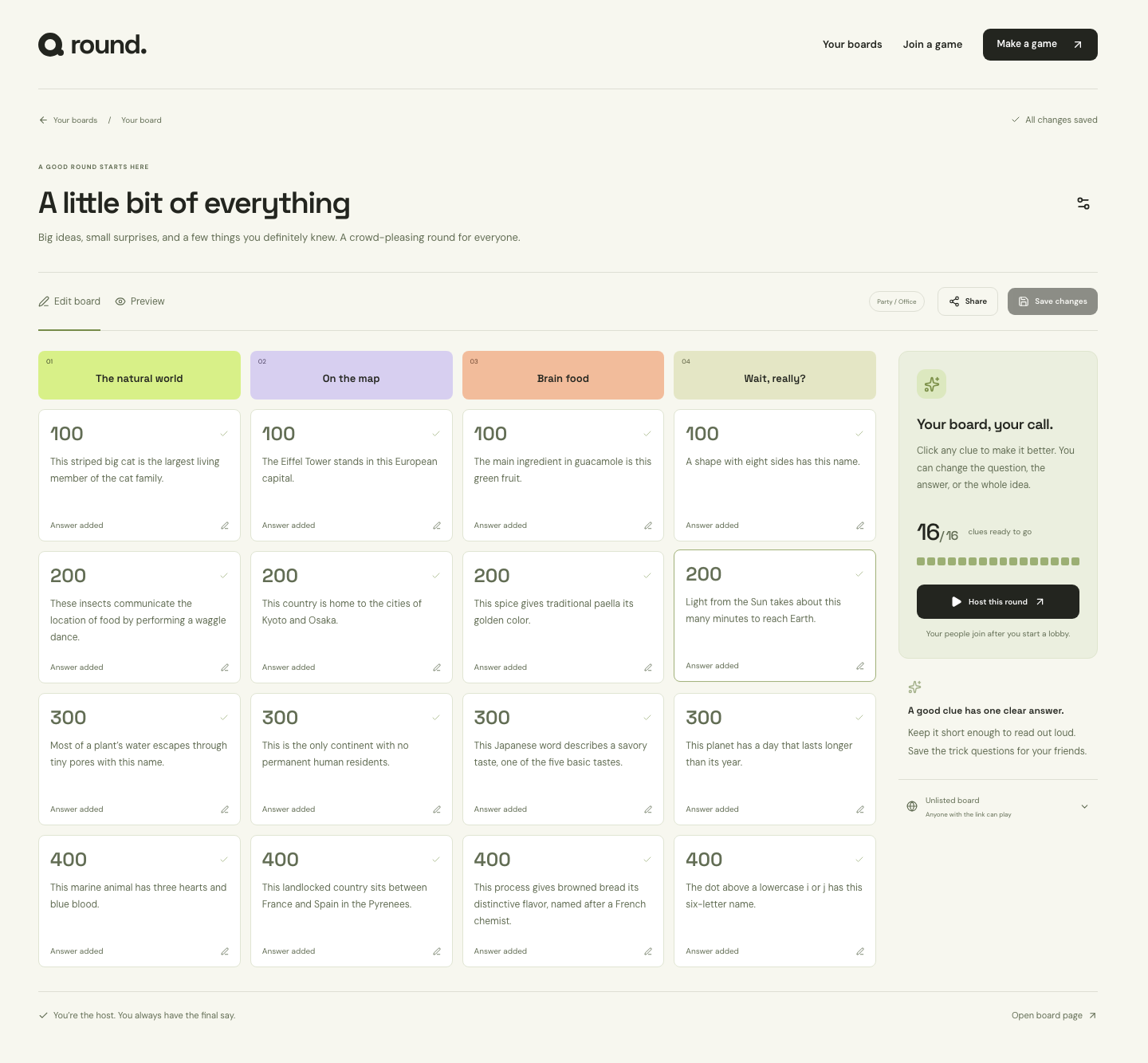
When the board looks like this, you are done writing. Hosting is a different job, and you should stop editing. The clue you tweak at the table, because you thought of a funnier wording, is the clue you will misread.
Questions that fall apart when spoken
A few shapes should be thrown out even if the fact is good.
"All of the following except" asks people to hold a list and a negation at the same time. They will buzz on item two. You will say "let me finish," and the room will already be in an argument. Ask for the one thing. "This planet has a day that lasts longer than its year" is a single target. The list of planets that do not was never going to survive the playlist.
Two-part questions are the same trap with better manners. "Name the country and its capital" means one team gets the country, another shouts the capital, and you are splitting points in your head. Ask for one of them. If you love both facts, they are two clues, a 100 and a 300, and the 300 can assume the 100 got played.
Anything that needs a picture you do not have on the screen. Lyrics that only work if you sing them, unless you are genuinely willing to sing them. Questions whose answer is "it depends," which are interesting at dinner and useless with an eight-second clock.
And the question you found on a list at lunch, from a subject your room has never touched. People can hear a fact that arrived from a search. The vocabulary is slightly off, or the example is one nobody in the room would have met, and the silence after it is different from the silence after a hard fair clue. Hard and fair sounds like thinking. Unfair sounds like a host who wanted to win.
Different rooms, different 400s
The sentence shape stays the same. The manners change, and if you ignore that you will embarrass someone who cannot leave.
At home, with friends, the best questions are about the people on the couch. A year of songs you shared. A season you watched together. Stories the group tells wrong, with the 400 reserved for the friend who was actually there. A column of pure outside-world facts is fine as one column, so the night is not only in-jokes, and deadly as all four, because then you are a pub quiz with worse lighting. There is a full evening plan for that room in how to host a trivia night at home.
At a fundraiser, assume a mixed age and a mixed willingness to be there. One column should be answerable from the flyer and the town. One column can be a dare. Skip clues that punish a family for not owning a subscription, a season ticket, or your particular degree. The prize structure and the ask are covered in trivia night fundraiser. The questions still have to be readable by a nervous volunteer with a microphone, which is a higher bar than readable by you.
In a classroom, the questions have to come from the unit you taught, plus one easy column from the room itself, the diagram on the wall, the rule you repeat. A 400 nobody was assigned is a betrayal, and students will treat it as one. That hour, including how the scoring should treat a miss, is Jeopardy classroom games for a real period. Do not import party scoring into a class because the questions felt spicy. A miss at school adds nothing. A miss among adults who asked for a trivia night can cost the value on the tile. Those are different promises, and the questions should match the promise. You do not write a gotcha for children and then charge them points for falling in it.
How many you need
One round is sixteen. You will be tempted to write thirty, because a list of thirty feels like preparation. Extra questions become a pile you rifle through while the room waits, and the waiting is where the night sags. Write the sixteen. If you want a second round, write a second sixteen with a different subject, and put food between them. If a clue dies in the room, reveal it and move. Do not replace it on the fly with one you half-remember from the internet. The half-remembered one is how you end up asserting a wrong capital with confidence, and someone will have a phone.
Eight seconds is the answer window once a team has buzzed. Ten seconds is how long you wait if nobody buzzes before you show the answer. Those clocks are why the sentence has to be short. A question that takes twelve seconds to read has already lost to the clock you meant as a kindness. Read the clue, open the buzz, and trust the people who were listening.
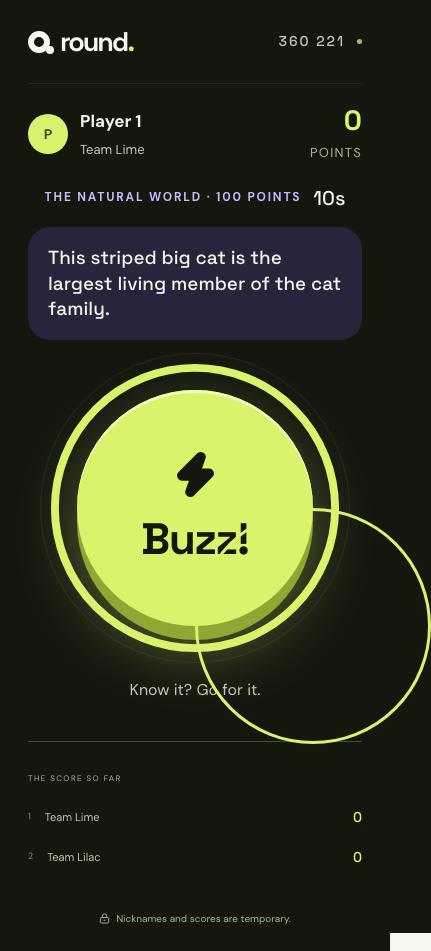
This is the other place the question has to fit. On the phone, in a box, with a clock beside it. If it looks like a paragraph there, it was a paragraph, and paragraphs are for after the reveal.
A way to check a question before you keep it
Read it once, to an empty room. If you run out of air, cut a clause. Cover the answer and ask whether a fair-minded person could land somewhere else and still be right. If they could, either add that landing to the accepted list or change the sentence until they could not. Then ask whether the point value matches the sweat. A gimme on the bottom row will get picked first, every time, and your careful 100s will never be played.
Do that sixteen times. It is a weeknight, not a project. The host who walks in with a checked board is allowed to be a person for the rest of the night. The host who walks in with a link to a hundred questions is going to spend the night editing in public.
Questions people ask when they want a list
Where do I get trivia night questions and answers?
Write them from the room you are hosting. A shared show, your town, the unit you taught, the cause on the flyer. A published list can shake loose a fact, and then you still have to turn that fact into one sentence with the answer removed and the other acceptable wordings written down. The list is a quarry. The card is the question.
How many questions are in a trivia night?
Sixteen is a full round, four categories of four. Ten or twelve is a better plan if you are inside a class period or a program that also has a raffle and a speech. Two rounds of sixteen, with a break, is an evening at home. More than that and you are producing a show.
What are good questions for people who do not usually play?
Names and places they have stood near. The 100s in every column should be gettable by someone who was listening to the invitation, not only by someone who likes quizzes. Put the obscure facts at 400, in a category whose title admits it is a dare, so missing them is a choice the team made.
Can I reuse questions?
Yes, with a different room. The same friends will remember Andorra if you used Andorra last month. A fundraiser crowd next year will not, and a new class has never heard your clues. Keep the board, change the three clues that flopped, and read the set out loud again anyway. A sentence that worked in your kitchen can still be one clause too long for a microphone.
Write the sixteen, then stop
Pick four categories the room has a reason to know. Put an easy fact at 100 and a stranger true one at 400. Take the answer out of the sentence. Write down the other wordings you will accept. Read the set once, out loud, before anyone is watching you do it.
Then host it. The questions are finished when the board is full, and the board can be hosted from the create page. Open the sample round if you want to hear what a one-breath clue sounds like in a real room before you replace every tile with your own.
Host a trivia night round
One screen, sixteen clues, phones as the buzzers. The trivia night boards are already written, or start from a blank grid.