Hosting note
How to Host a Trivia Night at Home
The text goes out on Thursday. Trivia at yours, Saturday, you will host. By the time people are on the couch you have a bag of chips, a laptop, and the HDMI cable that lives in a different room from the television. Someone will ask if this is going to feel like the bar, where a stranger with a microphone runs eight rounds and a table of regulars already knows the format. It will not feel like that, and it should not. A living room has six to twelve people who came to see each other. The game is the excuse.
How to host a trivia night, in a house, comes down to a screen everyone can see, one board of sixteen clues you have already checked, and a way to tell who buzzed first. Phones do that last job. You do not need a lighted buzzer set, a spreadsheet, or a microphone. You need the answers written down before the first person takes their shoes off, because judging from memory, with your closest friend staring at you, is how a nice night gets a small argument in the middle of it.
If you are a teacher looking for the classroom version of this hour, that writeup lives in Jeopardy classroom games for a real period. A family table, where the youngest player is done first, is family game night on the screen you already have. This one is for the couch.
What has to be true before anyone arrives
Pick the television or the wall, and stand at the far cushion while a clue is on the screen. If you have to squint, the type is too small or the lamp behind the couch is winning. Fix that while you are alone. Guests will not tell you they cannot read the 400s. They will miss them, and then they will decide your questions were unfair.
Teams want to be made before the grid appears. Two or three teams is the right number in an apartment. Couples who live together can share a team if the night is gentle, and they should be split if you want the room to get loud in a friendly way. Say which one you are doing when people walk in, so nobody has to negotiate their relationship in front of an audience. Three or four people to a team. A team of one will buzz faster than anyone and then resent the game for rewarding speed. A team of six will elect a spokesperson by the second clue and the other five will become a gallery.
One phone per team, face up, brightness up. The code on your screen is six digits. People join with a nickname. On a Saturday that nickname will be a joke, and that is fine, as long as you can say it out loud when you award the points.
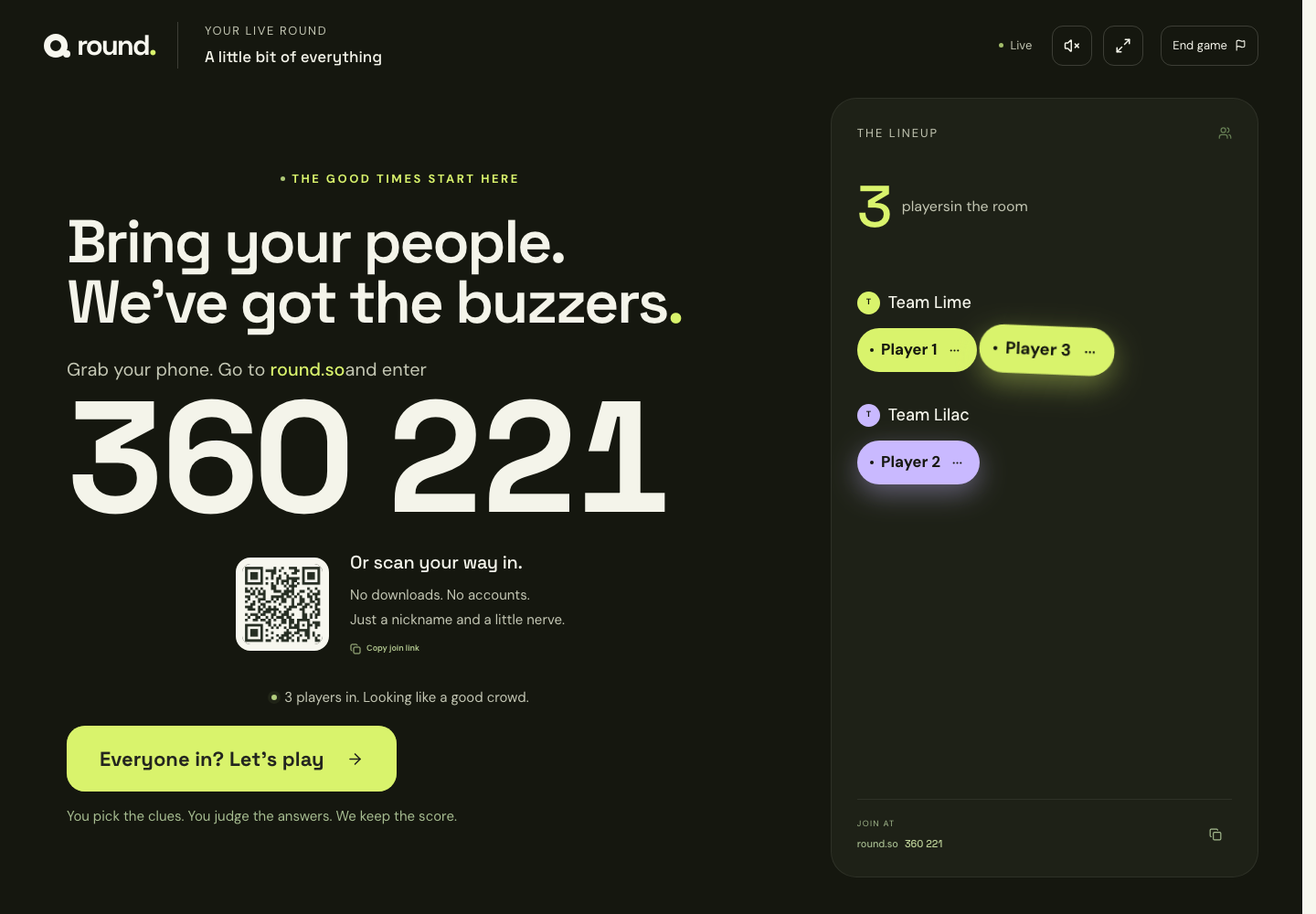
Leave this up while people are still finding a seat. The code is the instruction. You should not also be explaining the Wi-Fi password, the rules, and where the bottle opener is in the same minute.
The board itself is four categories and four clues, worth 100, 200, 300, and 400. That is one round, and once people understand buzzing it runs somewhere around twenty-five to thirty-five minutes. If you want a longer night, build a second board and eat between them. A third board is a hosting job. Take it only if you like the sound of your own rules more than you like your friends talking.
Categories that belong to the people in the room
"General knowledge" is what you write when you do not know who is coming. You know who is coming. The four columns can be a year of songs you all actually lived through, a show you finished and will not stop quoting, the city you are sitting in, and a column of stories the group tells slightly wrong. The 100s in that last column should be generous. The 400 should be a detail only one person remembers, on purpose, so they get a moment and everyone else gets to groan.
Write the answer first. Then write a sentence that points at it and does not contain it. "This striped big cat is the largest living member of the cat family" can be read in one breath, and the answer is tiger. "Discuss the taxonomic position of Panthera tigris relative to other felids" cannot be hosted over chips. If you stumble while reading a clue at the kitchen counter, rewrite it. Your friends will hear it once, under someone asking where you keep the glasses.
Put the other acceptable answers on the card before they arrive. Tiger and "a tiger" are the same call. You already know which friend will say "a tiger" to be precise, and you do not want to spend the night negotiating articles. If two answers would both be fair and you have not written that down, you will invent the rule while one team is winning, and the other team will hear the invention.
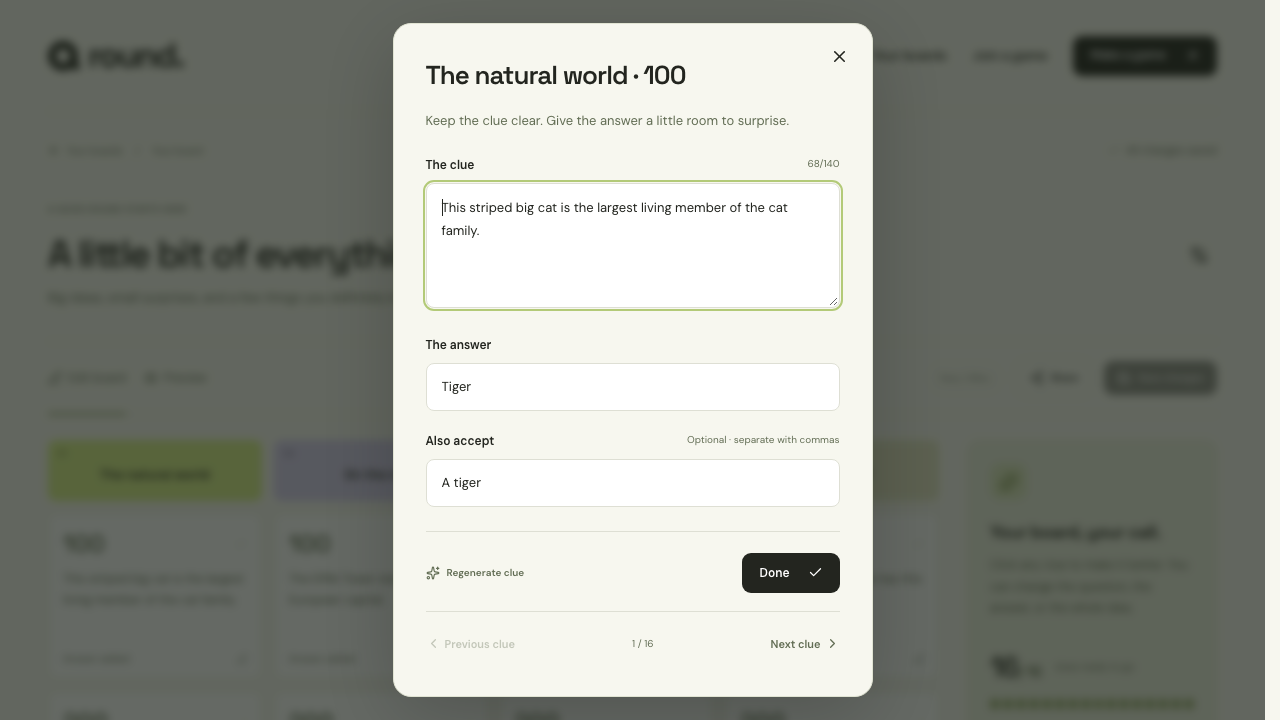
This is the whole card: the sentence you will read, the answer you want, and the versions you will take without a speech. Do it for all sixteen. It is less work than it looks, and it is the difference between a host and a referee who is making it up.
Difficulty has to climb with the points. If the 400s are soft and the 100s are riddles, your most competitive friend will go straight to the bottom row and the warm-up will sit there untouched. Let people land a few points before you make them sweat. A room that is already losing stops buzzing, and then they stop listening, and then you are hosting a show for two people.
The rules, said once, while the first tile is still closed
You read the clue with buzzing closed. Then you open it. A team that mashes the button while you are still talking does not win the race. That early press waits a quarter of a second after you open, which is enough to lose to the table that waited. Somebody will test this on clue one. Let them. The next clue will be calmer, and you will not have to repeat yourself.
The first team that buzzes clean gets eight seconds. At home, with adults who came to play, a wrong answer costs the value of the tile. That sting is why a party round feels different from a classroom review, where a miss scores nothing and the score cannot fall below zero. Pick the party version before you start, and do not switch when your brother-in-law starts bargaining. If you blow a call, and you will, because you like these people, fix that one score where everyone can see it and keep going.
Ten seconds of nobody buzzing and you reveal the answer yourself. Do not coax. Coaxing feels generous and it teaches the room to wait you out, and then every clue takes four minutes and the pizza gets cold.
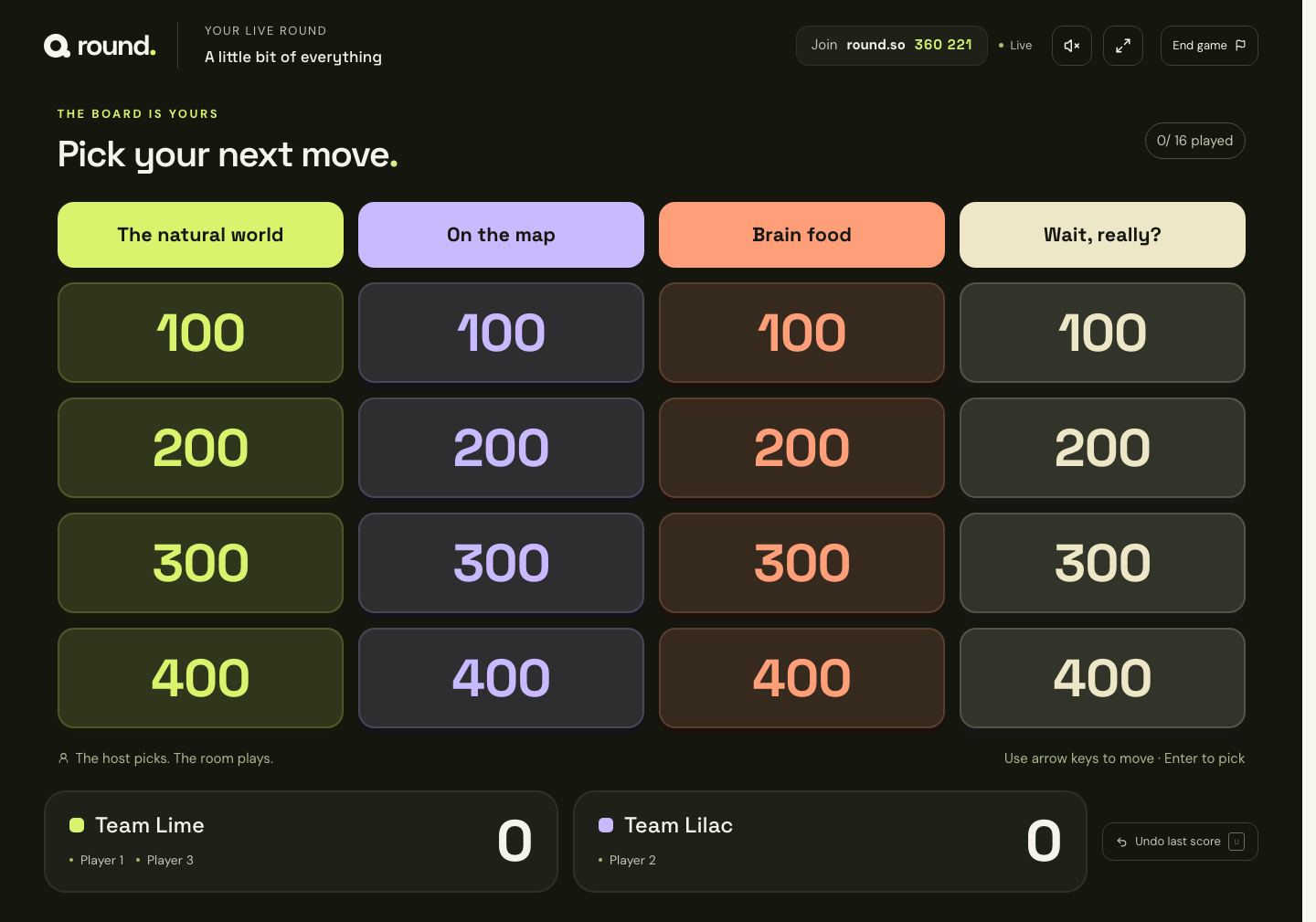
You pick the tile from this screen. Their phones are for buzzing, not for driving the grid. The score under the board updates without anyone adding on a napkin.
After a right answer, that team picks the next tile. Picking is the power, more than the points. Spread it on purpose if one table is running away with the night and the other table has gone quiet. You can do that without a speech. "Your pick, and then we'll take one from the other side of the room." People understand.
Food, and the second board
Snacks matter more than a second set of rules. Put them out before you start, not after clue four, or you will lose ten minutes to people standing in the kitchen narrating what you bought. Something that can be eaten with one hand. A drink within reach. If you are doing two boards, the break between them is dinner, not a pause where you hover and ask if the questions are too hard. Go to the kitchen. Let them talk. Come back when the plates are mostly done.
The second board should not be a harder copy of the first. Change the subject. If the first round was the city and the group lore, the second can be the show, the songs, a decade, a sport someone in the room cares about and is willing to lose at. Sixteen new clues. Same clocks. Same teams, unless a team is miserable, in which case you reshuffle at the break and you call it a halftime decision, not a mercy rule.
A date, if there are only two of you, is a different night. You can still use one phone each and the same board, and you should write clues you both might know, because a trivia date where one person runs the table is an interview. Keep it to one board. Leave time to actually talk. The game was the way you avoided sitting down and saying "so, how was your week" with nothing else in the room.
The friend who knows everything
Every group has one. They are delighted, and then they are a problem, because the other team can hear the delight. Give that person a job if you are not using phones, the job of writing down scores, which keeps their mouth busy. If you are using phones, the buzzer already limits them to their team's turn. What you still control is the categories. Do not build four columns out of their master's thesis. Build one column they will sweep, so they get to be brilliant, and three columns the rest of the room can live in.
If they shout an answer before anyone has buzzed, you ignore it. You said that at the start. Enforcing it once is enough. "We didn't hear a buzz." Then you open the buzz for real. They will be slightly wounded and the rest of the room will be relieved, and both of those feelings are correct.
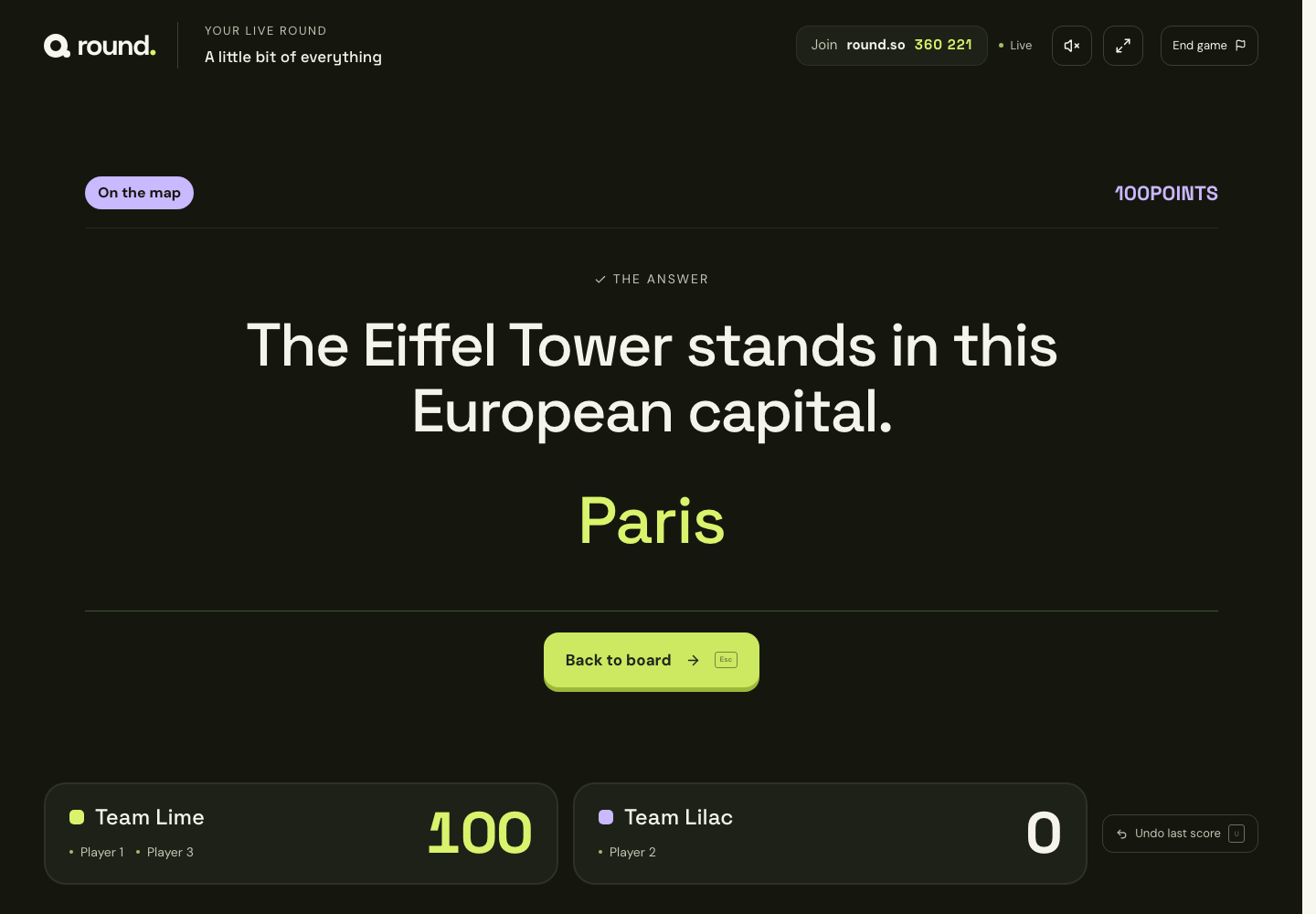
Say the answer, add one sentence if the room wants the story, and go back. The button is on the screen so you are not hunting through slides while someone tells you the Eiffel Tower story you did not ask for.
When the television and the Wi-Fi disagree
Apartments do this. The screen works, the phones do not, or half the phones are on a guest network that cannot see anything. You said the backup at the beginning, casually, so it does not arrive as a crisis. You point to the first person whose hand is fully up. They get eight seconds. You keep the same scoring. The board on the television still works. The phones were only there so you could read and judge without also being the referee. For one round, you can be the referee. Pour someone else the next drink while you do it, so the night still feels like a night.
Questions people ask before they agree to come
How long does a trivia night usually last?
One board is about twenty-five to thirty-five minutes once buzzing makes sense, plus the few minutes at the start while people join. Two boards with food between them is an evening, something like two hours if you count arriving and the part where nobody will leave. Three boards is a long commitment. Tell people which one you are hosting when you invite them, so the friend with an early morning can decide honestly.
What should people bring to trivia night at home?
A phone with some battery, if their team does not already have one on the table. Food if you asked them to. They do not need an app, an account, or a pencil. If you are the host, you bring the checked answers and the cable. Everything else is hospitality, and hospitality is not a rules sheet.
How do you play trivia at home if the group is tiny?
Two teams of two, or even two people with a phone each, still works. Skip the speech. Play twelve clues instead of insisting on all sixteen. End while you still like each other. A small room gets mean faster than a big one if the scores run away, so keep a column of easy points in every board and use them.
Do you need prizes?
You need a winner, because people will ask. You do not need a prize that matters. Bragging rights, the last slice, a ridiculous object that lives on their shelf until next time. A prize worth real money changes the way friends hear a close call. Save the serious prizes for a fundraiser, where the point of the evening is the money and everyone already knows it.
Saturday, with the board already built
Write the sixteen clues on a weeknight, from the people who are actually coming. Read them out loud once, in the kitchen. Get the cable out of the other room before they arrive. Put the code up, make the teams, play one round, eat, and play the second only if the room asks for it like they mean it.
You can build both boards and host them from the create page. The sample board is a decent way to learn the buzzers on a night when you do not want your own clues in front of your friends yet. When you do want your own, keep them. A second Saturday should not mean writing the city column again from scratch.
If the clues are the part you are stuck on, trivia night questions you can read out loud is the piece about the sentences themselves.
Host a trivia night round
One screen, sixteen clues, phones as the buzzers. The trivia night boards are already written, or start from a blank grid.