Hosting note
Family Game Night on the Screen You Already Have
The box is still in the hall closet, missing two cards and the die that rolled under the fridge in March. Someone suggests it every few weeks. Someone else remembers the argument. Family game night does not have to be that box. It can be the television you already watch, one board of sixteen clues, and the phones that are already in the room. You read. They buzz. You decide who was right. The score stays on the screen, which is the part a family usually loses to a scrap of paper and a person who “remembers” the points.
This is for the table you actually have. Kids and adults, or three generations, or two people and a teenager who would rather be somewhere else and might stay if the first clue is fair. It is not a classroom, though a classroom has its own hour in Jeopardy classroom games for a real period. It is not a pub quiz. The living-room version for friends on a couch is how to host a trivia night at home. A family night ends when the youngest person is done, not when the most competitive adult has proved a point.
One screen, and the phones you were going to take away
Put the board on the television. Sit where the smallest player sits and read a clue before anyone else comes in. If they cannot read it from that cushion, fix the type or the lamp now. Children will not file a complaint. They will shout a guess at the wrong time and then decide the game is for the grown-ups.
Teams can be generations, or they can be mixed on purpose so nobody’s team is “the kids.” Two or three teams is enough in a house. One phone per team, brightness up, held by a person who can tap when they mean to. A child can say the answer. An adult can hold the phone. That split matters. A seven-year-old with the only buzzer will either win every race or press it during the question, and both of those nights end in tears that were avoidable.
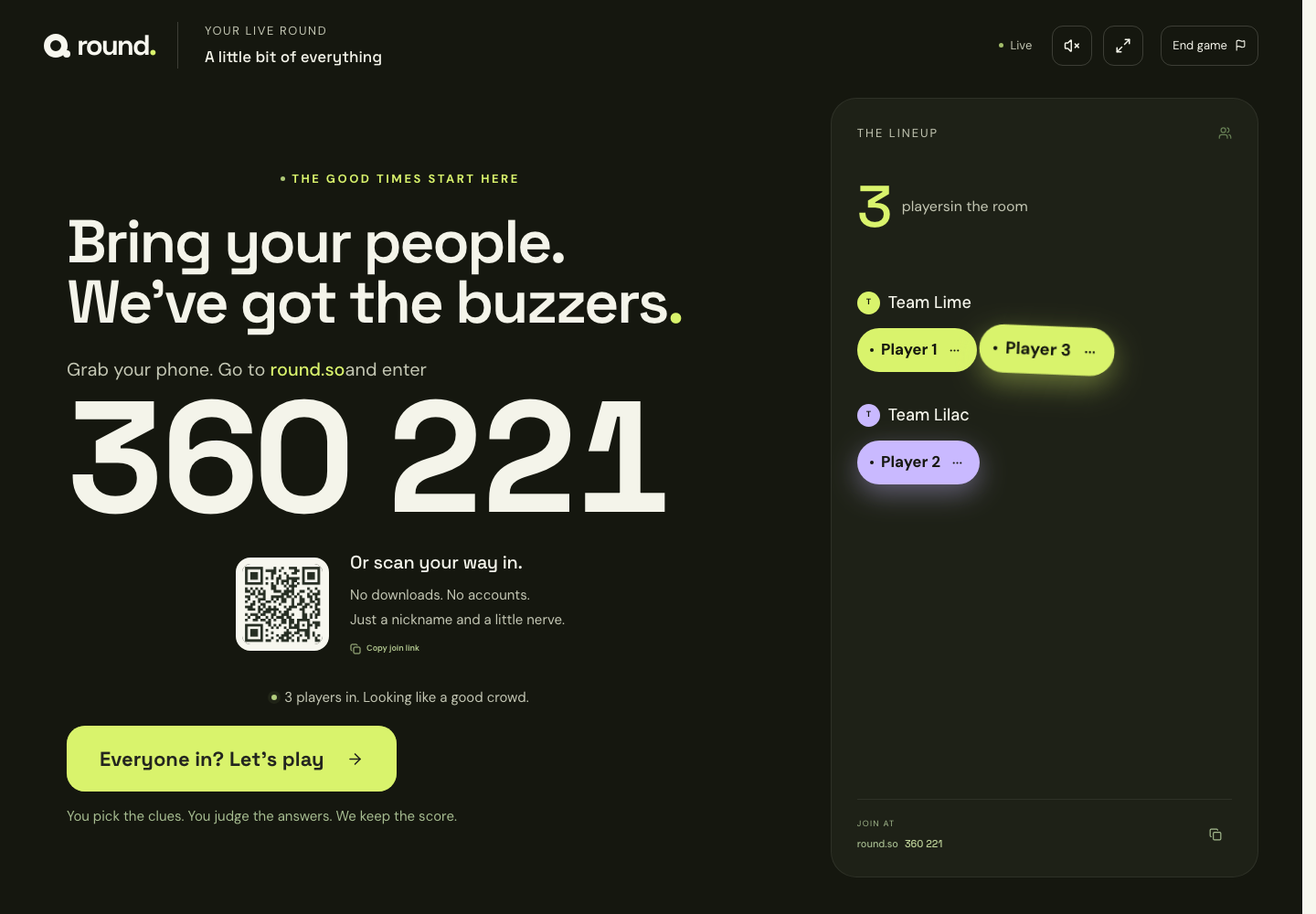
They join with a six-digit code in the phone browser. No app and no account. Free covers 20 people and 6 teams, which is a full Sunday table and the cousins who stayed for dinner. A larger room, a reunion that spilled into the yard, is a Night pass at $12 for 48 hours and 100 people, or Host at $6 a month or $48 for the year. Players never pay. The numbers are the same as the pricing page.
Leave the code up while people are still arguing about who sits where. The code is the instruction. You should not also be repeating the rules, finding the snack, and settling a seat dispute in the same minute.
Nicknames will be silly. Read them once before you start. If a name is a joke you would not want a grandparent to repeat, change it. You are the host. The screen is in the living room, not a group chat.
What belongs on a family board
Write the answer first. Then write a sentence a child can hear once and repeat. “This striped big cat is the largest living member of the cat family” can be a 100. The answer is tiger. The version you will also take is “a tiger,” and you write that down so you are not litigating articles with your brother. A family does not need the clue to be clever. It needs the clue to be finishable before someone asks what is for dinner.
Four columns. One that the kids can win: animals, a movie you have all seen, the town you live in, food. One that the adults can win, so they stay interested: a year they remember, a job, a place from before the kids were born, told kindly. One that is family lore, and this is the column you edit hardest. The 100s are stories everyone tells. The 400 is a detail one person remembers, on purpose, so they get a moment. It is not a grievance. If the story ends in a fight you are still having, it is not a clue. Play a different game if what you want is to relitigate Thanksgiving.
One column should be easy on purpose, all the way down, so a team that is lost in the lore can still score. Mixed ages fall out of a game when five clues pass and their side is at zero. You can see it happen. The child looks at the ceiling. The adult starts clearing plates. An easy column is how you keep them in the room without announcing a mercy rule.
Difficulty still climbs on the other columns. 100, 200, 300, 400. If the 400s are soft and the 100s are riddles, your most competitive relative will go straight to the bottom row and the warm-up will sit there. Let people land a few points. A family that is already losing stops buzzing, and then you are hosting a show for one person, which is the closet-board problem again.
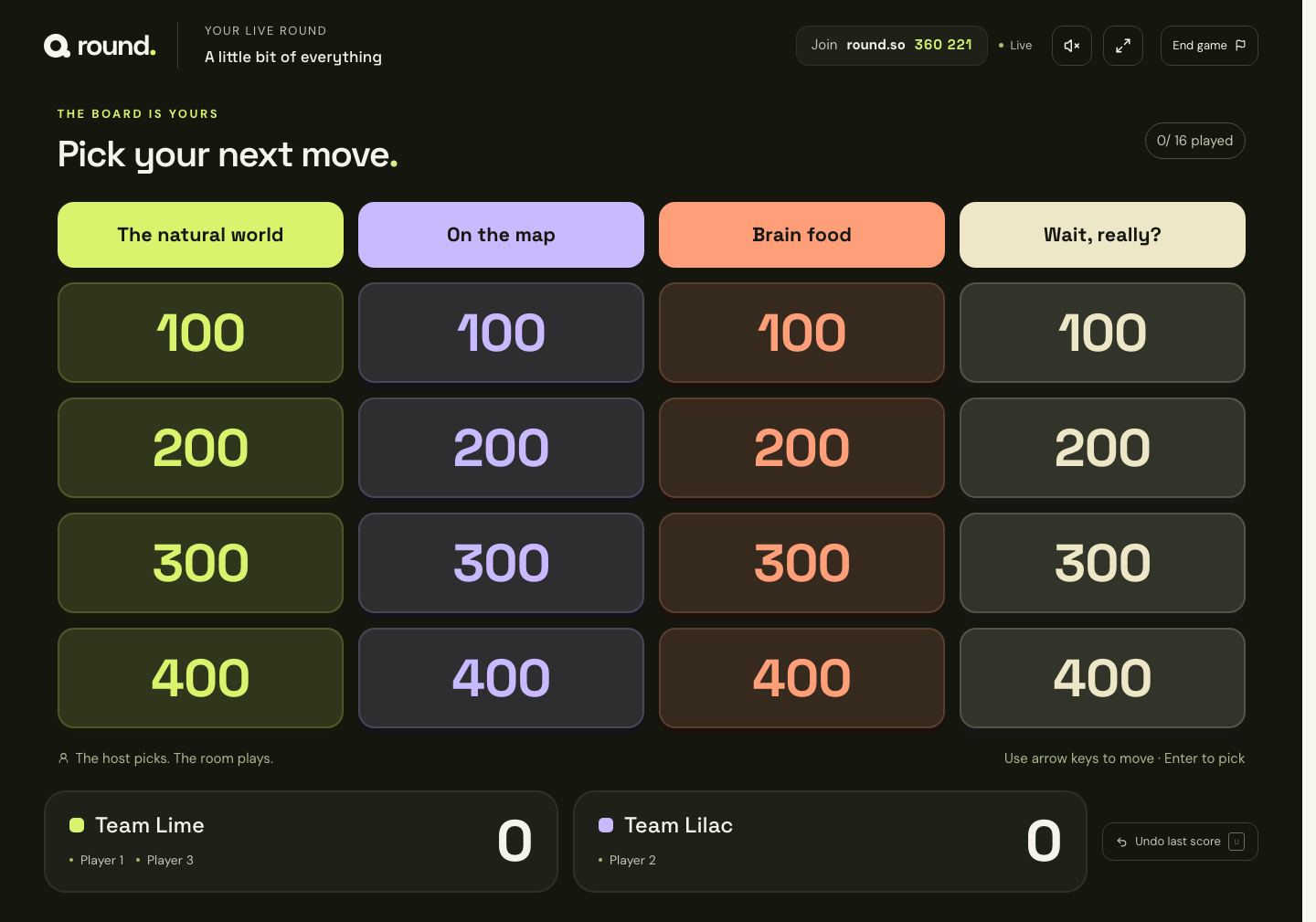
You pick the tile from this screen, or the team that just scored picks it. Phones do not drive the grid. The score under the board is the score. There is no second notebook.
The rule about points, said before anyone is mad
You read the clue with buzzing closed. Then you open it. A press while you are still talking does not win. That early press waits a quarter of a second after you open, long enough to lose to the person who waited. A child will test this immediately. Let them see it once. The next clue gets calmer, and you do not have to raise your voice.
The team that buzzes clean gets eight seconds. You decide right or wrong. The clock does not do it for you, which is useful when a kid is circling the answer and needs the last word. At a party, a wrong answer costs the value of the tile. In a kids’ room, a miss scores nothing and the score cannot fall below zero. That choice is on the way in: Friends and family keeps the sting, Kids takes it off. For a table with children who are actually playing, pick Kids. A deduction feels like a fine, and a fine from a parent, on a Sunday, is a different event from a game. For a table of adults who grew up together and want the sting, leave it. Do not switch halfway through because the scoreboard looks mean. You will look like you changed the rule for your own team.
Ten seconds of nobody buzzing and you reveal the answer. Do not coax a child through a 400 they do not know, in front of everyone, for a full minute. Coaxing feels kind and it teaches the room to wait you out. Say the answer, add one sentence if they want the story, and move. If they almost had it, you can say so in one line. You do not owe them the points.
After a right answer, that team picks the next tile. Spread the picks if one side has gone quiet. “Your pick, and then one from the other team.” Families understand turns. They have been arguing about them for years. Use that. Do not invent a new system with strikes and bonuses. The board already has a system.

Say the answer and get out of the way. The button back to the board is on the screen so you are not narrating a slideshow.
The relative who knows everything
Every family has one. They are delighted, and then they are a problem, because the children can hear that delight turn into a lecture. Give them one column. Let them sweep it. Build the other three for the rest of the room. If they shout an answer before anyone has buzzed, you ignore it. You said that at the start. “We didn’t hear a buzz.” Then you open it for real. They will be slightly wounded. The rest of the table will be relieved. Both feelings can be true, and you only have to enforce it once.
Do not let them host unless they asked to host and you want them to. The person who knows everything is a bad referee, because the close calls are the ones they care about. You can be the referee and still sit in the game’s gravity. You do not also play on a team if you are the one judging. A parent who judges and competes will not be believed, even when they are right.
Teenagers are a separate case. A board of clues about their childhood, written by you, can feel like a performance they did not agree to. Ask which column they want, or let them write four clues. Four clues is a small job and it changes whose game it is. A 100 they wrote for a younger cousin is a better Sunday than a 400 you wrote about their middle-school haircut. If they do not want to play, they can hold a phone for a team or they can be in the room without a job. Forcing a turn is how you get a person staring at a different screen. You already know that screen. The game will not beat it by being mandatory.
Food, bedtime, and stopping early
Eat before you start, or eat after, but do not deal a clue between bites unless the food is the kind you can hold in one hand. A family night dies in the kitchen. Someone gets up to refill, the buzzer is on the table, and the team that stayed starts winning by attendance. Put the bowl down first. Play. Then get up.
One board is the night. Sixteen clues is enough. If bedtime is a hard stop, play the top two rows and call it. Eight clues, said in advance, is a finished game. Sixteen clues abandoned at the third column because someone has school in the morning feels like a loss even when the score is close. Tell them which length you are playing when you turn the television on.
You need a winner. You do not need a prize. Bragging rights, the last biscuit, choosing tomorrow’s breakfast. A prize that matters will make a sibling hear a close call as favoritism. If the scores are miserable for one team, you still end. You do not add secret points. You say the score, you say what was fun, and you stop. Next week’s board can have a wider easy column. This week’s board is over.
If the television and the Wi-Fi disagree, you already have a backup because you play in the same house every week. Point to the first hand that is fully up. They get eight seconds. You keep the same answers. The board on the screen still works. The phones were there so you did not have to be the referee and the reader and the scorekeeper with a pen. For one round, you can be all three. Then you fix the network before the next Sunday, not during it.
Questions families ask before they deal the first tile
How do you play with mixed ages?
Put an adult’s hand on the phone and let the child call a lot of the answers. Build one column the kids can win and one the adults can win. Pick Kids if children are buzzing, so a wrong answer does not take points away. End when the youngest player is finished, even if the adults want the 400s.
How long is a family game night?
Eight clues if you have bedtime. Sixteen if you have a real half hour and nobody is melting. One board is the plan. A second board is how a nice night becomes the argument from the closet. Save it for a week when they ask.
What if the questions turn into a fight?
They were the wrong questions. Cut the clue, say the answer, move on. Do not litigate a family story in front of the score. Next time that column is animals, or the town, or a movie, until you trust the room with lore again.
Do the kids need their own phones?
No. One phone per team. They do not need an app or an account. If you would rather the phones stay in a basket, play with hands and keep the board on the television. The screen is the part that makes it a game instead of a quiz you are shouting across the table.
Sunday, with the board already built
Write the sixteen clues on a weeknight, from the people who will actually be there. Read the kids’ column out loud to an empty room and listen for a word they will not know. Swap it. Get the television input right before you call everyone in, because the minute you spend on the remote is the minute someone opens a different game.
You can build it from the family boards, from a page of family notes, or from a blank grid on the create page. Pick Kids when the table has children playing. Pick Friends and family when it is adults and you want a miss to cost the tile. Keep the board. Next month should not mean inventing the animals column again.
If you are stuck on the sentences, trivia night questions you can read out loud is about writing a clue in one breath. A family night needs that more than a bar does. You get one reading, over someone asking whether the dog has been out.
Host a family round
One screen, sixteen clues, phones as the buzzers. The family boards are already written, or start from a blank grid.