Hosting note
Jeopardy Classroom Games for a Real Period
You can usually tell, in the first minute of review, who the period belongs to. One student has a hand up before the question is finished. Two more know the answer and will only say it sideways, to a friend. Everyone else has already decided this is not their conversation, so they open a notebook and wait for the quiz tomorrow, which was the thing you were trying to head off.
Jeopardy classroom games are the fix teachers reach for, and the search phrase is a little misleading. What people want is a review board: four categories, four clues in each, worth 100, then 200, then 300, then 400. The grid goes on the projector. A team picks a tile. You read the clue out loud. Somebody buzzes, you decide whether the answer counts, the score changes where the whole room can see it, and you come back to the grid. Sixteen of those will eat a period if you lecture between them. Ten or twelve, played quickly, will teach more than a worksheet and still give you the last five minutes back.
This is written for a teacher with one projector that mostly works, phones that are already in the room, and about twenty minutes after the last bell to build the board. The same grid will also carry a living-room trivia night or a short one at work. Leave the television show's set, music, and clue archive where they are. Jeopardy! is a trademarked program. What follows is the classroom shape people have been running for years, with your unit and your wording.
What the hour needs from the board
A slide template will give you the grid, and then it will leave you holding every other job. You are the person who notices that column two, third tile, already went. You are the person who hears two answers at once and has to pick a winner without looking like you picked your favorite. You are the scorekeeper, working from a sticky note that you stop trusting around clue six. By 2:10, with a full class and a projector fan, that is a worse job than teaching.
What lasts the hour is plainer than a template gallery makes it sound. You need the sixteen clues written before anyone walks in. You need teams of three or four, named before the grid appears, so the naming does not become the activity. You need a buzzer that remembers who was first, because your ears will not. You need to be free to read and to judge. And you need a clock with a spine, so a clue that nobody knows is allowed to die.
Round is that set of jobs split across a laptop and a phone. The host screen is the one on the projector. Players join with a six-digit code, no account and no app to install. You pick the tile, then you open the buzz on purpose. The first phone that is allowed to answer gets the clue. A right answer adds the value on the tile. In a school game a miss adds nothing, and the buzz opens again for every team that has not already tried. If you are hosting adults who came to sweat, a party round can subtract the value instead. Ten seconds of silence and the answer shows itself. Once someone has buzzed, they get eight seconds to say it.
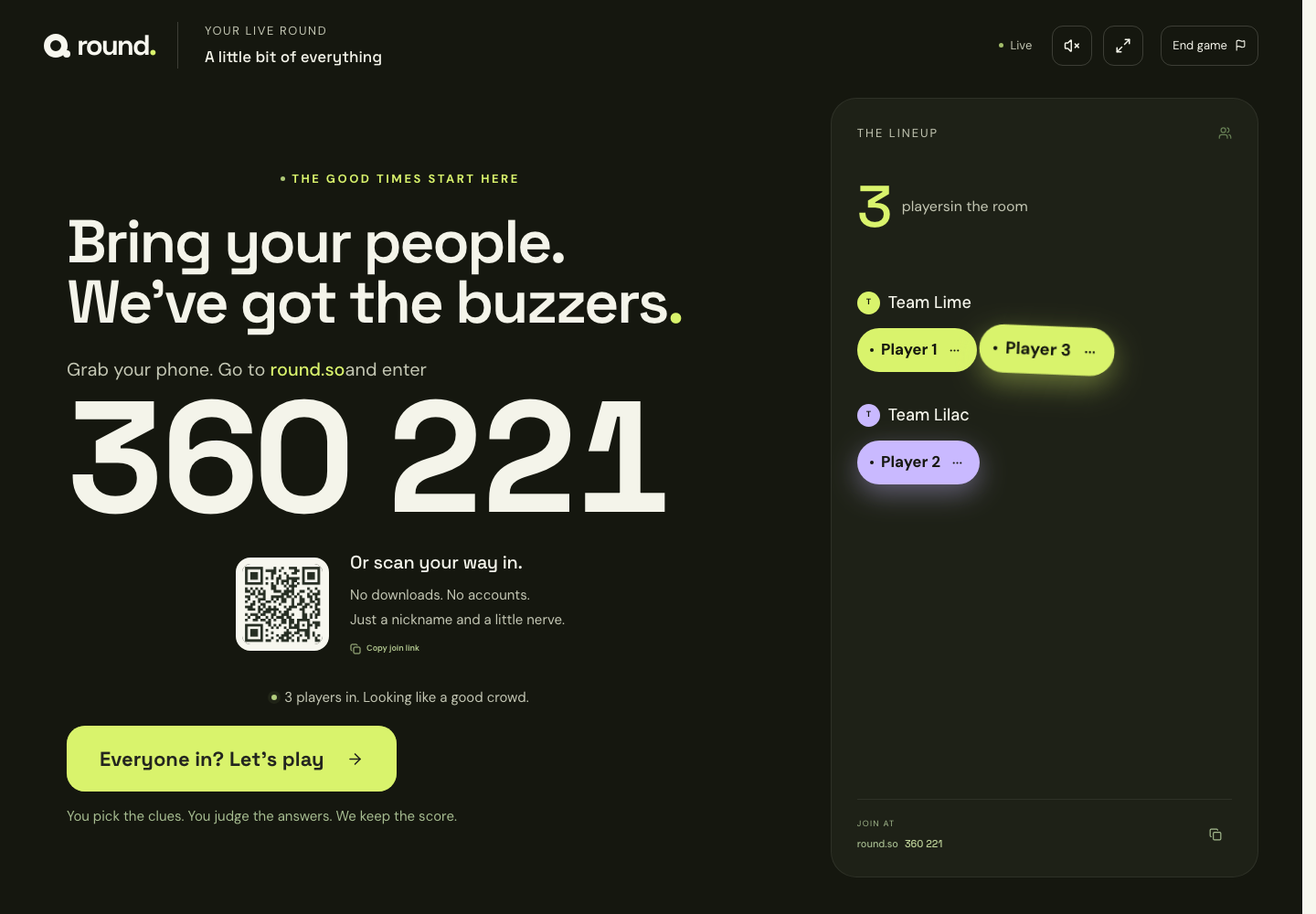
The code has to be readable from the back row, and it has to stay up while you take attendance. In this lobby, 360 221 is the whole instruction. Nicknames land on a team. Nobody has typed an email.
Paper cards can carry the same shape, and so can a careful slide file. The clocks matter more than the software. A review with no cutoff becomes a seminar about partial credit, and the students who like seminars will keep you there.
Twenty minutes, if the categories are narrow enough
Four categories. Four clues. The values stay in order, 100, 200, 300, 400, because the climb is the point of the grid. If the board takes you longer than twenty minutes, the categories are too wide, or you are writing little essays and calling them clues.
Pull three categories from the unit you are about to test. Spend the fourth on the room itself. The safety line you have said so often that students mouth it with you. The diagram that has been on the back wall since September. The word you banned from lab reports after the third time it showed up as a substitute for thinking. Those hundred-point tiles are how a team that is scared of the test gets onto the scoreboard before the hard clues start, and a team with points will buzz again.
A biology hour might be Cells, Genetics, Labs, and something like "Said it in class." Category labels have to stay short if you want them to fit on a projected grid. Twenty-four characters is the ceiling in Round, which is a useful shove: "Cellular respiration" becomes "Respiration," and the longer phrase was never going to be readable from the last row anyway.
Write the answer before you write the prompt. Then write a sentence that points at the answer and refuses to contain it. "This organelle packages proteins for delivery" is a clue. "The Golgi apparatus packages proteins" is a sentence from the chapter, and half the class will buzz on the noun they recognize, which feels like a win and teaches nothing. Read the prompt in one breath. A limit of 140 characters sounds fussy until you hit it and realize the second sentence was throat-clearing. Answers should be a few words, around sixty characters, because you are going to judge them while twenty-eight people watch your face.
The variants belong on the card before the bell, not in your head. Tiger and "a tiger" are the same call, and you should not make a fifteen-year-old sweat the article. Stomata and stoma are the same call. Mitochondria and "the powerhouse of the cell" are different calls, unless you decided last night that the nickname counts and you wrote that down. The argument starts when you make that decision live, with a team convinced they said the thing you wanted and a rival team convinced they did not.
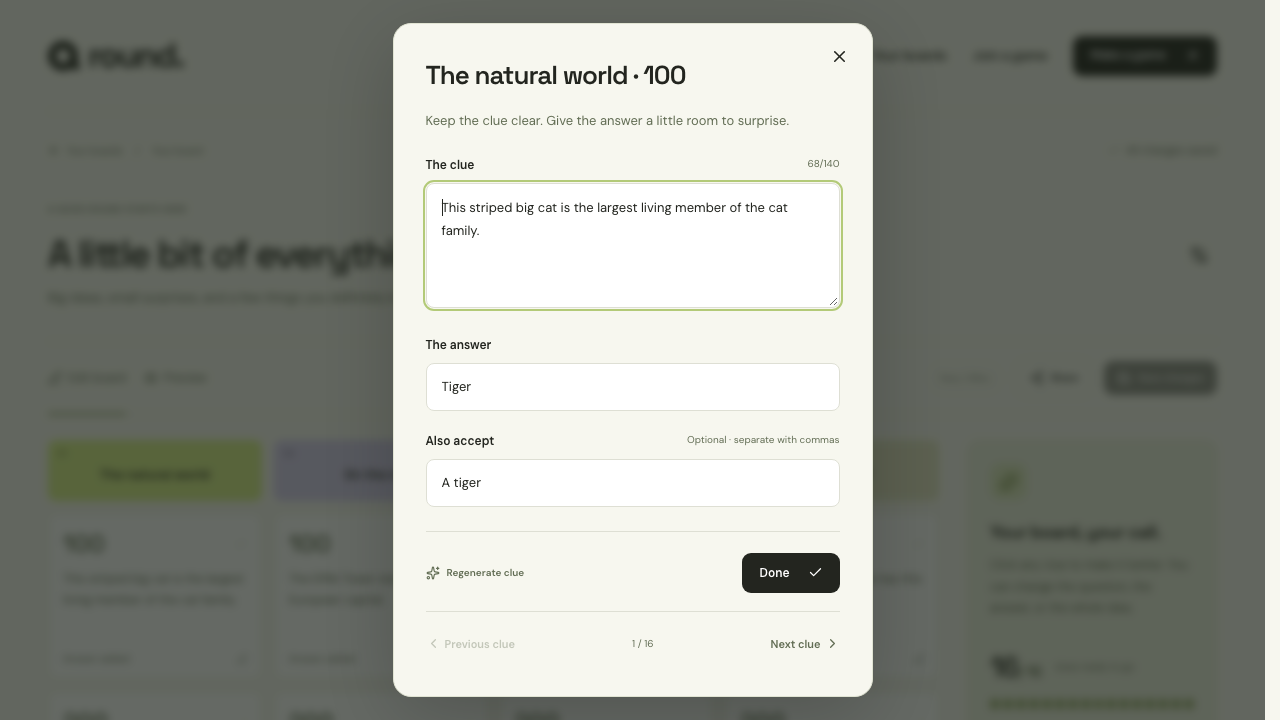
This is the card you want finished before class: the clue, the answer, and the versions you will take. The counter in the corner, 68 of 140 characters, is there so the clue still fits in one reading.
A finished column, stolen from a general-knowledge board rather than a unit test, sits like this.
100. This striped big cat is the largest living member of the cat family. Answer: Tiger. Also take "a tiger."
200. These insects tell each other where food is by performing a waggle dance. Answer: Honeybees. Also take "bees."
300. Most of a plant's water leaves through tiny pores with this name. Answer: Stomata. Also take "stoma."
400. This marine animal has three hearts and blue blood. Answer: Octopus.
Difficulty has to climb with the points. If your 400 is "name the organelle from yesterday" and your 100 is a riddle, every team with a pulse will raid the bottom row and leave the warm-up sitting there. The warm-up is the studying. Henry Roediger and Jeffrey Karpicke reported in Psychological Science in 2006 that taking a memory test beat spending the same minutes restudying the passage, when they checked again days later. A student who has to say "stomata" out loud is in that experiment. A student watching you click forward to a revealed answer is closer to rereading the paragraph, which feels productive and fades. John Dunlosky and colleagues, reviewing study techniques in 2013 for Psychological Science in the Public Interest, rated practice testing high-utility, ahead of highlighting and rereading. A category board earns its period when the clues force that retrieval. It wastes the period when the clues are so pleased with themselves that only you know what you were pointing at.
Read them at your desk, once, out loud
They will hear each clue a single time. The projector fan will be going. Somebody will ask for the bathroom pass in the middle of the 300. If you stumble on a clue at your desk, with nobody watching, you will stumble worse in front of them, and then you will explain, and the explanation will give the answer away.
Some shapes do not survive being spoken. "All of the following except" falls apart as soon as it leaves your mouth, because the exception arrives after the list and half the room buzzed on item two. A clue that depends on a diagram you left in the workroom is a clue you cannot host. Two-part questions are a trap you set for yourself: the team answers the first half, you hesitate, their rivals start shouting the second half, and now you are mediating. For a school board, leave out violence, alcohol, romance, horror, and brand trivia. Those can be funny at a party where everyone is an adult and nobody has to see you at lunch the next day.
What you want, almost every time, is a name, a number, or a short phrase. "1945" can be judged in a second. So can "mitochondria," and so can "the control group." "Explain the role of the control group in Tuesday's lab" cannot be judged in a second, and the eight-second answer clock will expire while they are still finding the verb. Save your explanation for after the reveal. One sentence from you, then back to the grid. The next clue is the next time they have to pull the idea out of memory, which is the part that sticks.
The same fact, written the way it comes out at 10 p.m. and the way it should go on the board:
The long one: "Thinking about the plants we put in the window on Tuesday and the plants we put in the closet, what did we call the group that did not get the light, and why did we bother including it?"
The one you can host: "In the window-and-closet lab, this group got no light." Answer: the control group.
The long version is a prompt you would enjoy writing, because it shows you remember the lab. The short version is a prompt a fourteen-year-old can finish before the clock dies. If they miss it, your one sentence after the reveal can carry the "why."
If the board is coming from notes you paste in, every answer has to be sitting in those notes. Students can hear a 400 that you found at lunch. The vocabulary is slightly off, or the example is one they never saw, and the room goes quiet in a different way. If you are writing from memory of the unit, check the three hardest answers against the text before you project them. A wrong key, up on the wall, is a long week, because someone will quote it back to you on the quiz and they will be right to. A saved board lets you open one clue in the morning and fix the word. Rebuilding a slide master to change that same word is how a planning period disappears into clicking.
The student who always shouts, and the team that never does
Three or four to a team. Pairs sound tidy and then you have fourteen phones in the air and no one is sure which pair buzzed. Groups of six or seven invent a spokesperson by the second clue, and the other five become an audience, which is the problem you already had. Name the teams before anyone sees a single number. "The Late Passes" will play harder than "Team 3," and the naming takes a minute if you let them do it while you are still getting the code on the screen. If you let them do it after the grid is up, you have lost the first ten minutes to branding.
Raised hands fail in a way that feels fair and is not. The same three students answer, because they are fast and because you are grateful somebody answered. Everyone else stops preparing an answer they will not get to give. After a few clues they are not even listening for the clue. They are listening for whether their name is about to be called. A buzzer moves the decision off your attention. One phone per team, face up, on the join screen. The six-digit code stays large. Nicknames are enough, and a class game should not be asking anyone for an email address so you can host a review.
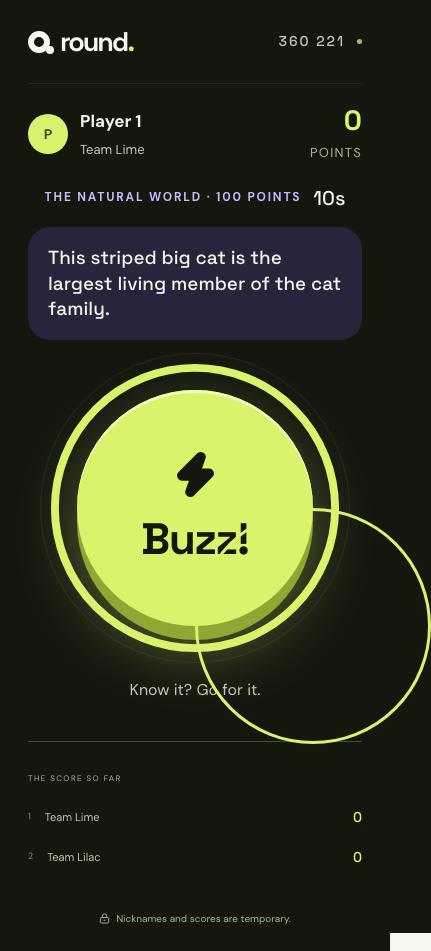
One phone, one team. The clue is on the phone as well as on the wall, the ten-second mark is visible, and the button is large enough that a nervous captain does not have to aim.
You say the rules once, before the first tile, and then you let the first tile teach them.
You read the clue with buzzing closed. Then you open it. A team that leans on the button while you are still talking does not win the race. That early press sits out for a quarter of a second after you open, which is long enough to lose to a team that waited. It sounds small. On clue one, somebody will test it, the buzz will go to the patient table, and you will not have to explain the rule again. The first eligible buzz gets eight seconds. If they are right, they score the tile and they pick next, which matters more than the points, because picking is power and the quiet teams notice who has it. If they are wrong in a school game, nothing is subtracted. The buzz opens for everyone who has not missed yet. Ten quiet seconds, and you reveal it yourself and move.
"Close" is your call, and the call has to feel like the same person made it on clue two and clue twelve. If the variant was written on the card, take it, even if you are tired of that team winning. If they added a detail that changes the meaning, turn it down. Say why in one line. "Chloroplast is the one that does the light. We wanted the pores." Then the next team can buzz, or you reveal, and you do not hold court. Arguments about a judgment wait until the scores are up at the end. If you stop the room on clue six to relitigate clue two, you have taught them that stalling works, and the rest of the period will be stalling.
School scores stay at zero or above. A team that eats three 400s and watches a negative number will stop buzzing, and a few minutes after that they will stop bothering to know the answer, because the game has told them they are out of it. Party scoring can subtract the face value of the clue. Adults who showed up for a trivia night often want that sting. Pick one style before you host, and do not switch when a team starts complaining, because the complaining is the tell that the rule is clear. If you blow a call, and you will, fix that one score in the open. There is an undo on the host screen for a reason. Use it where they can see you use it, so the correction does not look like a favor.
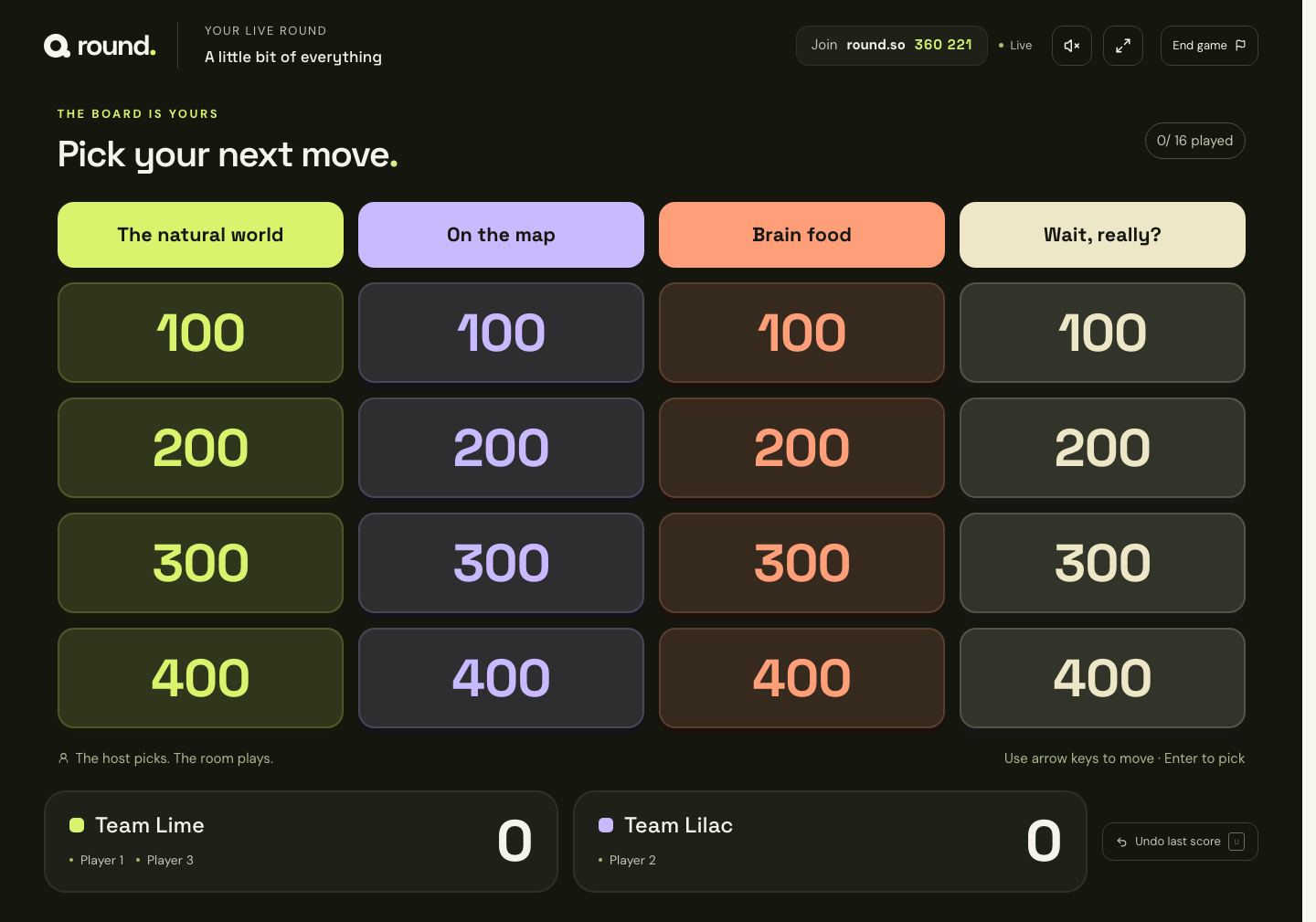
This is the screen on the projector once you have started. You pick the tile. The room does not click anything on this grid. Their phones are for buzzing, and the scores under the board update without you doing the arithmetic.
A 45-minute period, from the door to the bell
Have the board up before they enter. The code should be readable from the seat by the door, not from the seat where you stand. While you take attendance, teams sit together and one phone joins. If a phone is dead, that team pairs with a neighbor's phone for the hour. Do not spend the opening on charging cables.
The rules take about two minutes if you refuse to repeat them. Then you play an easy 100 yourself, all the way through: read it, open the buzz, take the answer, put the points on the board, come back. That sample is the instruction. A second speech about sportsmanship is how you lose the minutes you needed for the last retrieval.
From there until about minute thirty-eight, play ten to twelve clues. Leave the ugly 400s for a team that asks for them. When a clue is dying, and you can hear it dying, reveal it at the ten-second mark instead of coaxing. Coaxing feels kind and it teaches the room to wait you out. Twelve finished clues, with a one-sentence reveal after the misses, will beat four clues that turned into discussions. You can have the discussion tomorrow, on the two ideas they missed, when you are not also running a game.
With five minutes left, read the scores without a speech about how everyone tried hard. Then put one missed answer back in their mouths, with no points attached. Ask it plain. Wait. Let more than one voice say it. Roediger and Karpicke were writing about the test, not about the celebration afterward, and that last untimed retrieval is the one most likely to show up on Thursday's quiz.
Then the phones go down and you end the game on the shared computer. Nicknames from fifth period do not need to follow anybody home, and a lobby left open on a classroom machine is a lobby the next class will wander into.
If the Wi-Fi folds, and in plenty of buildings it will, you already told them the backup. You become the buzzer. You point to the first captain whose hand is fully up, and you keep the eight-second clock by counting it. Say that rule at the start, casually, so when the network coughs it looks like a plan. The phones are there so you can read and judge without also refereeing a shout. When the phones cannot do it, you referee, and you do it visibly, and you do not apologize for the building.
One clue, played the long way, so the short way makes sense
Suppose the tile is Labs for 200, and the clue is the short one: "In the window-and-closet lab, this group got no light."
You read it. You do not add "remember, we talked about why controls matter." You open the buzz. Team Lilac hits early, during the word "closet," and that quarter-second penalty costs them. Team Lime buzzes clean. Their captain says "the independent variable." You want to help them. You do not. Independent variable was a respectable guess and it is wrong for this clue, so the school score stays where it was, and you say, "Not this one. Buzz is open." The Late Passes get there with "control" and you take it, because control and "the control group" were both on your card. You add 200. You say, "The closet plants were the control, the ones we compared the window plants against." Then you are back on the grid, and the Late Passes are picking, and the independent-variable table is annoyed and awake, which is a better state than annoyed and done.
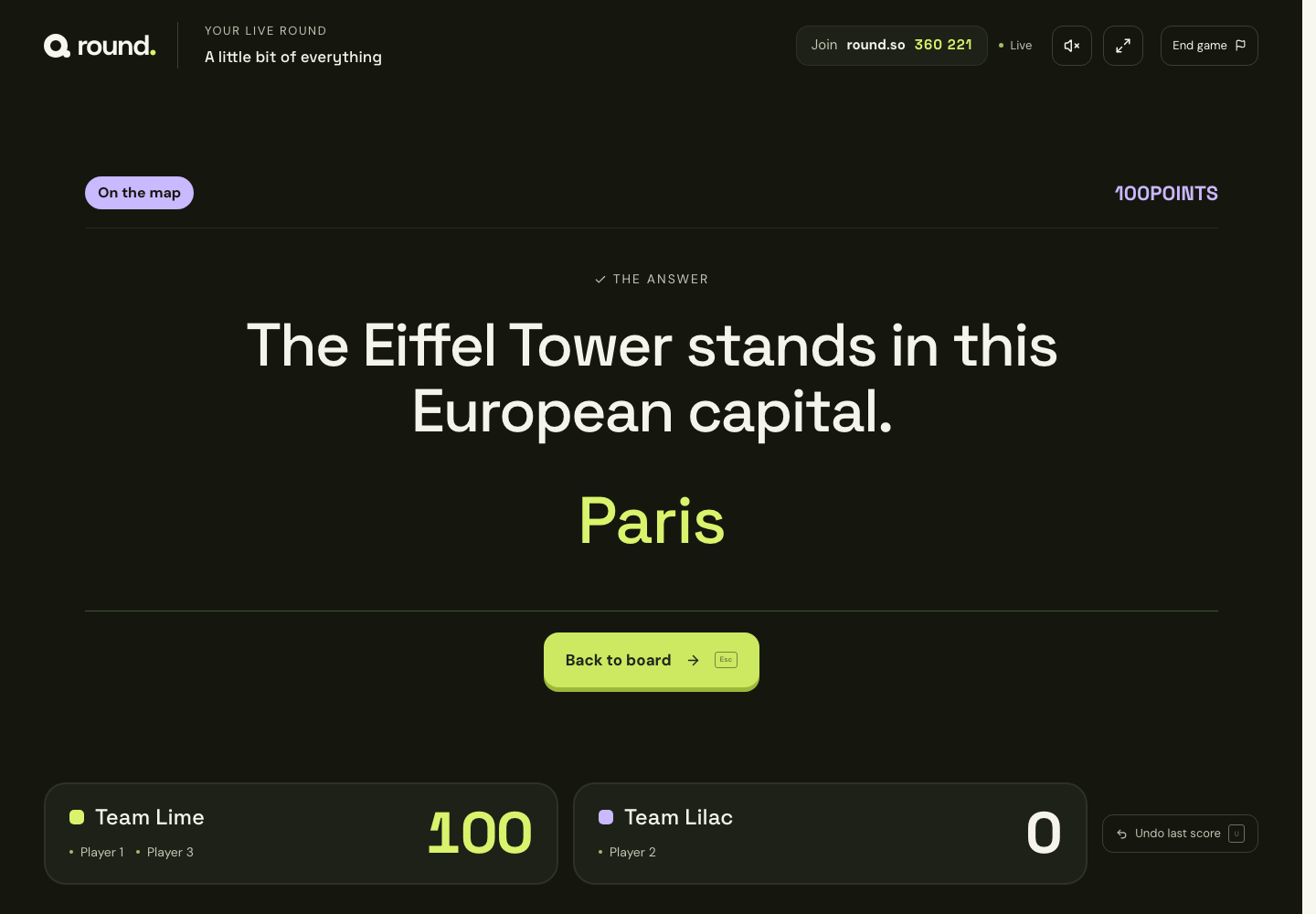
After you judge, the answer and the new score are on the same screen. One sentence from you, then back to the board. The button is right there so you do not hunt for it.
That sequence is about forty seconds when you let it be forty seconds. It becomes four minutes if you explain independent variables, let Lilac argue that they buzzed first, and retell the lab. You can retell the lab after the game, to the two tables that missed, while everyone else starts the exit ticket. During the game, your generosity has to be the next clue, not a longer speech.
Templates, and the work they politely skip
Search for a jeopardy template, a powerpoint jeopardy template, or a version built in Google Slides, and you will find files that look finished because the grid is already drawn and the colors are already loud. A file like that is a reasonable tool when you are alone at the front and the class is writing answers on paper, then checking them when you advance the slide. Everyone retrieves at once. Nobody has to be first. That is a good study structure on a day when you want quiet.
It is a poor structure on a day when you want teams, speed, and a score the back row can see without squinting at your handwriting. The failures are so regular they are practically a genre. A hidden link drops you on the answer slide while you are still reading the question, and the class makes the sound classes make when they have been robbed. Somebody taps the clicker that was living too close to the laptop edge. The score, which lived in your head, stops agreeing with the score a student wrote down. Two kids yell a name. You award it to the one closer to your desk, and you know you did, and so do they.
Index cards still win in a building where the network is a rumor and you want an object that cannot log out. A live room wins when you want the first buzz stored and the total on the screen without you adding in your head. Both of them still require the sixteen clues. The template was the part that looked like the work. The clues, and the pace you keep while hosting them, are the work. If you will run this review again next term, save the board and change the three clues this class could not say. Your boards can be copied and hosted again, which means October's version can become the January version without you reconstructing a pile of hidden slides on a Sunday.
The same grid at home, at work, and when someone is raising money
People who search "how to host a trivia night" are usually standing in a bar, a church hall, or their own living room, wondering how many rounds they need and whether they have to buy a buzzer system. Teachers arrive at the same grid from the other direction, looking for classroom trivia games that feel a bit like a show. The tiles do not change. The manners do, and ignoring that is how a perfectly good board embarrasses somebody.
At home, the categories can be the people on the couch, which is more fun than a category called "general knowledge" and also harder to write. One year of songs you all actually lived through. A season of a show you finished together, with clues mean enough to be fair. The city you are sitting in. A column of stories the group tells slightly wrong, where the 100s are generous and the 400 is the detail only one person remembers, on purpose, so they get a moment. Six to twelve people, two or three teams, one phone each. Once buzzing makes sense, a single board runs somewhere around twenty-five to thirty-five minutes. A second board, with food between them, is an evening. A third board is a hosting job, and you should only take that job if you like the sound of your own rules.
At work, one board over lunch, and make it obvious that leaving is allowed. Categories from the product, and from the harmless lore, the coffee situation, the meeting that has a nickname. Leave out bodies, dating, and anything a person could imagine printed and slid across a table in a review. People play looser when they trust the game cannot be used on them later. If you cannot make that promise, host something else.
A fundraiser wants the game to be the program, not the warm-up that ate the program. About a dozen clues, then one sentence on what the money is for, while they are still in a good mood and have not started gathering coats. Then the rest of the board. Then stop. Two boards fit a night with friends. Three fit a fundraiser that also has a welcome and a thank-you and a raffle you refuse to rush. Past that, you are producing a show, and the clues have to be better than a weeknight can honestly support. You do not need a bar's sound system for any of this. You need a screen, a host who can talk over people chewing, and answers you checked that afternoon, including the ones you are sure you remember.
Before you open the door
The categories come from the unit, or from the room you are standing in, not from a list of clever topics you meant to get to. Four across, four down, answers written before the prompts that point at them. You have read each clue out loud at your desk. Teams are three or four, with one phone and a hand-raise backup you mentioned at the start so it does not look invented. School scores will not go below zero, even if a team begs you to make it "more real." You are playing for pace, and you are leaving enough time to put one missed idea back in their mouths with the points turned off.
If a coordinator wants the worksheet to avoid the television title, call it a review board and play the same hour. The learning was never in the lettering. Copying the set, the theme music, or clues from the broadcast is a different project, and a worse one, because your students were in the room when you taught the fact and a famous clue was not. The safety notes are short on purpose. Nicknames only. A class game is a bad place to collect names you do not need.
Questions that come up while the board is still blank
How do you play trivia in a classroom and still get to the exit ticket?
Keep it to ten or twelve clues, in teams of three or four, with eight seconds to answer once someone has buzzed. Stop with five minutes on the clock even if the bottom row is untouched. The board is a retrieval drill that happens to have a score. Prizes, a speech, and a rematch will not fit between the bell and the quiz, and the quiz is why you built the board.
What do you need in the room to host a trivia night?
A screen everyone can see, a host, sixteen answers you have already checked, and a way to know who buzzed first. Phones do that job well. A strict hand-raise does it in a building where the Wi-Fi has a reputation. A classroom or a living room does not need a microphone, a lighted buzzer set, or a spreadsheet. It does need the answer key written down before the first person sits.
Can a school run a game that looks like this?
Yes, with categories you wrote and clues you can stand behind. Leave the show's logo, the theme, and the broadcast clues out of the slides and off the worksheet. If the title makes someone nervous, "review board" is a complete description of the hour. Students will remember who buzzed and what the score was. They will not remember the typeface.
Is a free PowerPoint template enough, if I already have one?
Enough on a day when the whole class is writing, and you are revealing the answer to everyone at the same time, and you like being the person with the clicker. It will not write the sixteen clues, and it will not decide which of two shouts arrived first. For a review you intend to run every unit between now and June, a board you can reopen and edit breaks less often than a file full of hidden slides and links you no longer trust.
Host it on the unit you taught
Pick four categories from what you have already taught, including one that lets a nervous team score early. Put a clue in each box that you can say in one breath, and write down the answers you will accept before anyone can argue with you. Read the whole set out loud once, at your desk, and fix the sentence you stumble on. Project the board, put the code where the back row can read it, and end the round while there is still time to hear a missed answer a second time, with no points riding on it.
You can build that board and host it from the create page. Open the sample round first if you want to see the buzzers with a room that is not your fifth period, or type the unit clues and keep the board for the next class that needs the same hour.
The same grid shows up in other rooms. How to host a trivia night at home is the Saturday version. Trivia night fundraiser is the evening with a door price and a raffle. Trivia night questions you can read out loud is about the sentences themselves, before anyone is in the room.
Sources
Dunlosky, J., Rawson, K. A., Marsh, E. J., Nathan, M. J., and Willingham, D. T. (2013). Improving students' learning with effective learning techniques: Promising directions from cognitive and educational psychology. Psychological Science in the Public Interest, 14(1), 4-58. doi.org/10.1177/1529100612453266
Roediger, H. L., III, and Karpicke, J. D. (2006). Test-enhanced learning: Taking memory tests improves long-term retention. Psychological Science, 17(3), 249-255. doi.org/10.1111/j.1467-9280.2006.01693.x
The board rules in this piece, including the 4 by 4 grid, values of 100 to 400, the 140-character prompts, the quarter-second delay on an early buzz, the 10-second buzz window, the 8-second answer, and school scores that cannot fall below zero, match the game as it runs in this project. The screenshots are from that same build.
Host a classroom review round
One screen, sixteen clues, phones as the buzzers. The classroom review boards are already written, or start from a blank grid.