Hosting note
Office Team Building Games That Fit in a Lunch Hour
Somebody booked the room from 12:10 to 1:00 and wrote "fun" on the invite. The people who accepted did it with a calendar hold, not with enthusiasm. They have a standup at 1:05. A trust fall will not fit, and neither will a deck about communication styles. What fits is a game they can see the end of. Sixteen clues. One screen. Phones as buzzers. Done before the next meeting starts looking at them through the glass.
Office team building games fail when they ask colleagues to perform a personality they do not use at work. A board fails less often, because the thing they are asked to do is ordinary. Hear a sentence. Decide if their table knows it. Buzz, or let it go. The host, who is usually the person who got volunteered, reads and judges. Nobody has to share a fear.
If the hour you needed was a classroom, that version is Jeopardy classroom games for a real period. If the night is a couch and a bag of chips, start with how to host a trivia night at home. A Friday that is a party, not a lunch, is office party games for the hour after work. This one is for the room with a badge reader on the door.
What you can finish before 1:00
Four categories, four clues, worth 100, 200, 300, and 400. That is the whole round. Once people understand the buzz, it runs somewhere around twenty-five to thirty-five minutes, which is a lunch hour if you stop talking between tiles. A second board is an offsite. Do not promise one on a Tuesday.
Teams of three or four, named before the grid appears. People who sit next to each other can share a team. Split the two people who already finish each other's sentences if you want the room to get louder. One phone per team, face up, brightness up. A table where everyone buzzes from their own phone will spend the clue arguing about who pressed. Tell them that at the start, while the code is still on the screen.
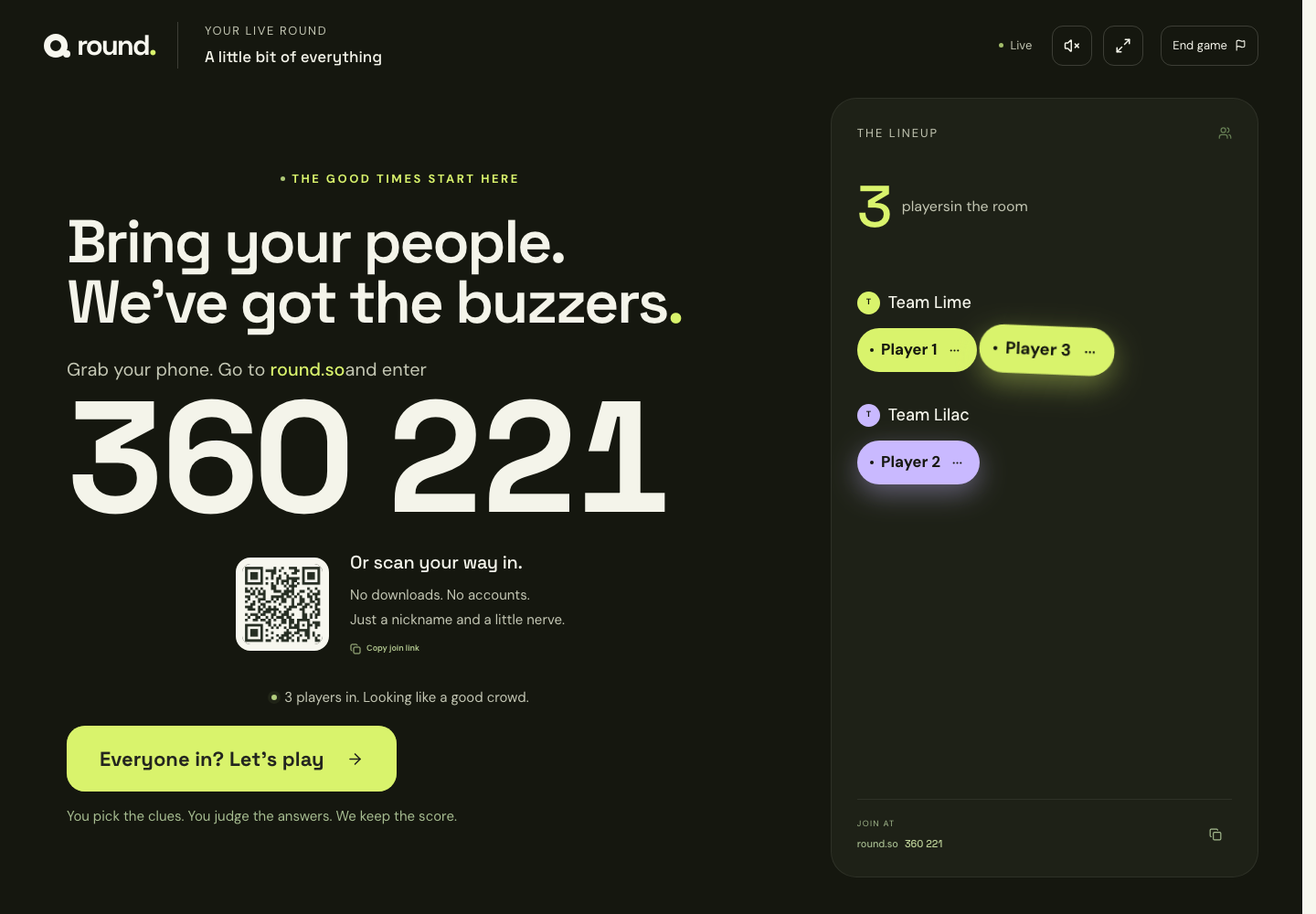
Leave the six-digit code up while people are still finding a chair and deciding whether the lunch they brought counts as attending. The code is the instruction. You should not also be explaining the Wi-Fi, the rules, and whose budget bought the sandwiches in the same minute. Players join in the browser. No app, and no account.
Categories from the work, not from a catalog
"General knowledge" is what you write when you do not know who is coming. You know who is coming. They share a product, a building, a slack channel, and a set of stories that are slightly wrong. Use those.
One column can be the product, in language a new hire could still answer. One can be the office itself: the printer, the room you book so a call stays quiet, the day most people leave a little early. One can be the habits you wish were written down: who removes a blocker, what a memo is for, how a decision gets an owner. The fourth can be the city, or the year the company started, or a customer story that is allowed to be told. Keep the 100s generous. A team that is quiet in meetings needs a point on the board before the 400s start, or they will stop buzzing and you will be hosting a show for the two people who already talk the most.
Write the answer first. Then write a sentence that points at it and does not contain it. "The short meeting that happens standing up" can be standup. "Discuss the cultural implications of synchronous standups in hybrid organizations" cannot be read over a sandwich. If you stumble while reading a clue at your desk, rewrite it. Your colleagues will hear it once, under someone asking if there are more napkins.
Put the other acceptable answers on the card before they arrive. "Standup" and "stand-up" are the same call. Decide that on Monday, not when a director is watching you invent the rule.
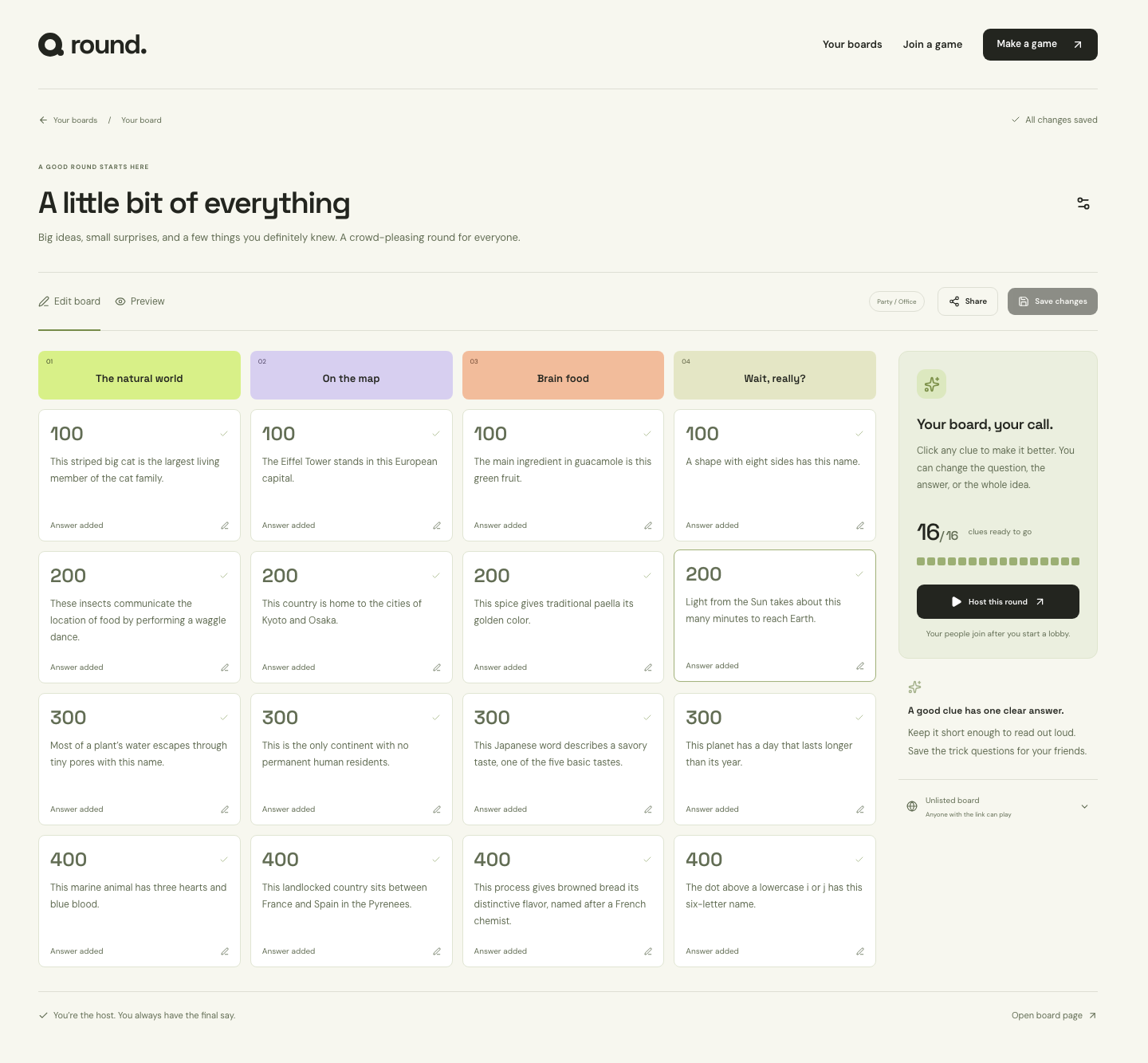
Sixteen of sixteen, filled, is the job. A list of fifty icebreakers is a document you will not host.
The rules, said once
You read the clue with buzzing closed. Then you open it. A team that mashes the button while you are still talking does not win the race. That early press waits a quarter of a second after you open, which is enough to lose to the table that waited. Somebody from sales will test this on clue one. Let them. The next clue will be calmer.
The first team that buzzes clean gets eight seconds. At work, with adults who did not come to be humiliated, a wrong answer should not wreck the afternoon. You can play it as a party, where a miss costs the value of the tile, or you can play it so a miss scores nothing and the score cannot fall below zero. Pick before you start. Do not switch when the quiet team starts bargaining. If you blow a call, and you will, because you like these people, fix that one score where everyone can see it and keep going.
Ten seconds of nobody buzzing and you reveal the answer yourself. Do not coax. Coaxing feels kind and it teaches the room to wait you out, and then the 1:05 meeting starts while you are still on the second category.
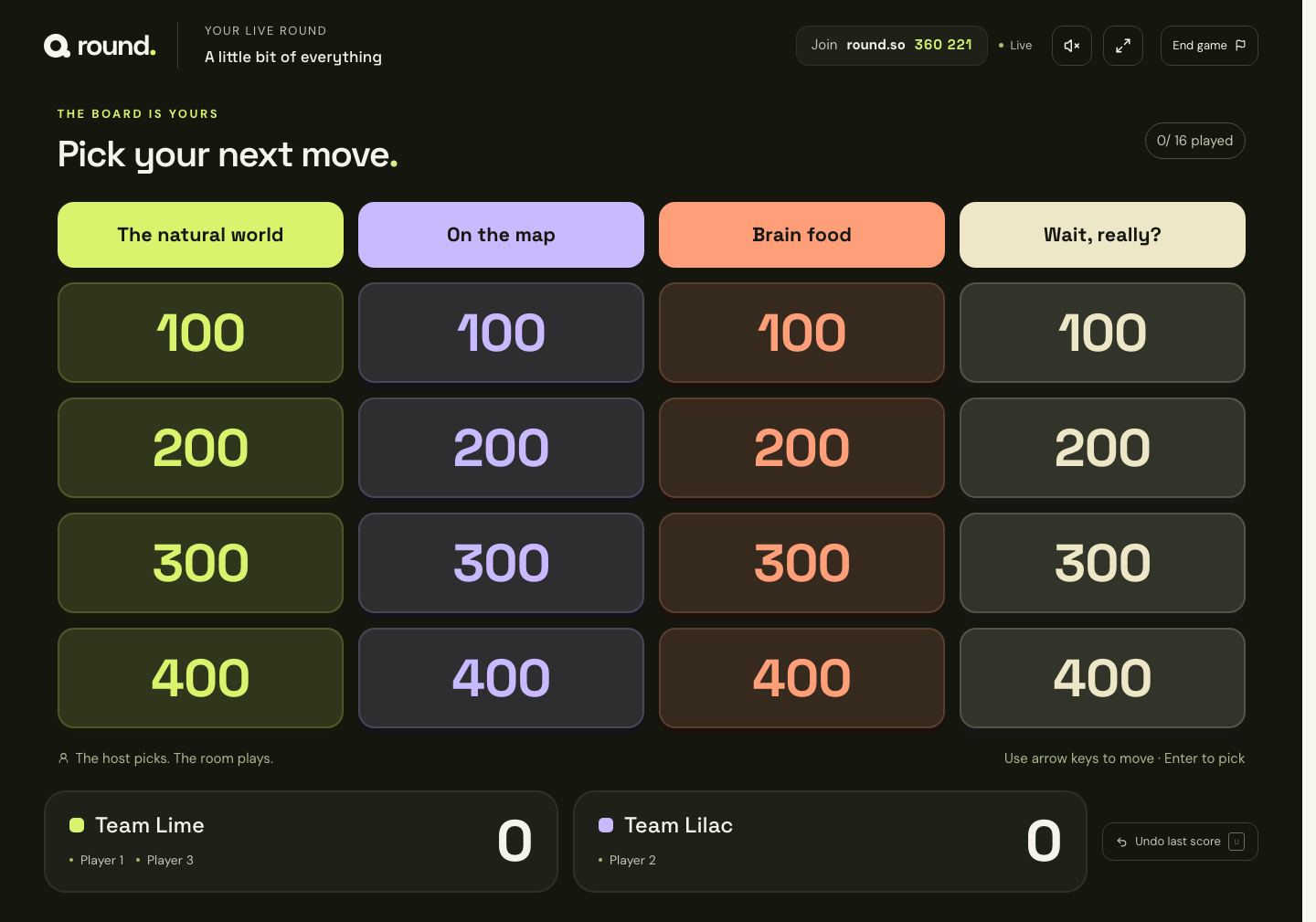
You pick the tile from this screen. Their phones are for buzzing. After a right answer, that team picks the next tile. If one table is running away with it and the other has gone quiet, hand the next pick across the room without a speech. "Your pick." People understand.
What not to put on the board
Skip anything a person would not want said in front of their manager. The nickname, the vacation that went badly, the slack message that was funny in a thread of four. A 400 can be a detail only one team remembers. It should not be a detail only one person is embarrassed by. If you have to ask "is this okay," it is not on the board.
Skip the company values, printed as clues. People can recite them and they will feel the way a poster feels. A clue about the actual work is kinder, because getting it right means they were paying attention to each other, not to a laminated card.
If the group is remote, one person shares this screen and everyone else keeps their phone. Cameras can stay off. The game does not need a face. Virtual team building on one shared screen is that hour, including the part where half the laptops are on a guest network.
Questions that come up when someone forwards the invite
How long do office team building games need to be?
One board is about twenty-five to thirty-five minutes once buzzing makes sense, plus a few minutes while people join. That is a lunch hour. Two boards is an afternoon, and you should say so on the invite. A team with a hard stop at 1:00 will like you more for ending at 12:55 than for squeezing in a bonus round.
Do people need an app?
No. A phone browser and the six-digit code. One phone per team is enough. They do not make an account, and they do not pay. If a phone dies, you can point to the first hand that is fully up and give that team eight seconds. The board on the screen still works.
What if the same three people always win?
Give them one column they will sweep, so they get to be good at the thing they are good at, and three columns the rest of the room can live in. Do not build the board out of the staff engineer’s reading list. The point of the hour is that more than one table wants to buzz.
Can we reuse the board next quarter?
Yes. A board about the office ages slowly. Change the column that mentioned a launch, leave the printer joke, and host it again for the people who joined since. You already did the hard part, which was writing answers you can stand behind.
Book the room, then stop adding activities
Write the sixteen clues the day before, from the people who will actually be there. Read them once, out loud, at your desk. Put the code on the screen before the first person arrives with a fork. Play one round. End while they are still willing to stay for the last answer. If someone asks for another, that is next month, and you already know which column to keep.
You can start from a finished office board on the team building boards, or write your own on the create page. The sentences themselves, if that is the part you are stuck on, are in trivia night questions you can read out loud.
Host a team building round
One screen, sixteen clues, phones as the buzzers. The team building boards are already written, or start from a blank grid.