Hosting note
Virtual Team Building on One Shared Screen
The invite says cameras on, which already lost half the people you wanted. They will come if the hour has an end and a job they understand. Virtual team building games usually hand them a poll, a whiteboard, or a breakout room where two strangers ask each other what they would do with a million dollars. A board is plainer. One person shares the screen. Everyone else has a phone. You read a clue. A team buzzes. You judge. Sixteen of those and you stop, and the people who stayed off camera still got to play.
This is the same grid as a room you can see. Four categories, four clues, 100 through 400. The difference is that you cannot tell who is lost by looking at their face, so the rules have to be even more visible, and the round has to be even more willing to end.
The in-person lunch is office team building games that fit in a lunch hour. The couch is how to host a trivia night at home. A video call is the lunch hour with worse audio and a better excuse to finish on time.
Who shares, and who buzzes
One host shares the board. That is the only screen that matters. If everyone has the grid on their own laptop, you get eight people clicking and a conversation about whose turn it was. Their phones are the buzzers. They join with the six-digit code in the browser. No app, and no account. Cameras can stay off. A voice is enough, and a buzz is enough when they do not want to talk yet.
Teams of three or four, named in the chat before you share the grid, or the naming becomes the meeting. People in the same city can share a team even if they are on separate calls. One phone per team. If a team of four all buzz from their own phones, they will spend the clue deciding who was allowed to. Tell them to pick a phone while the code is up.
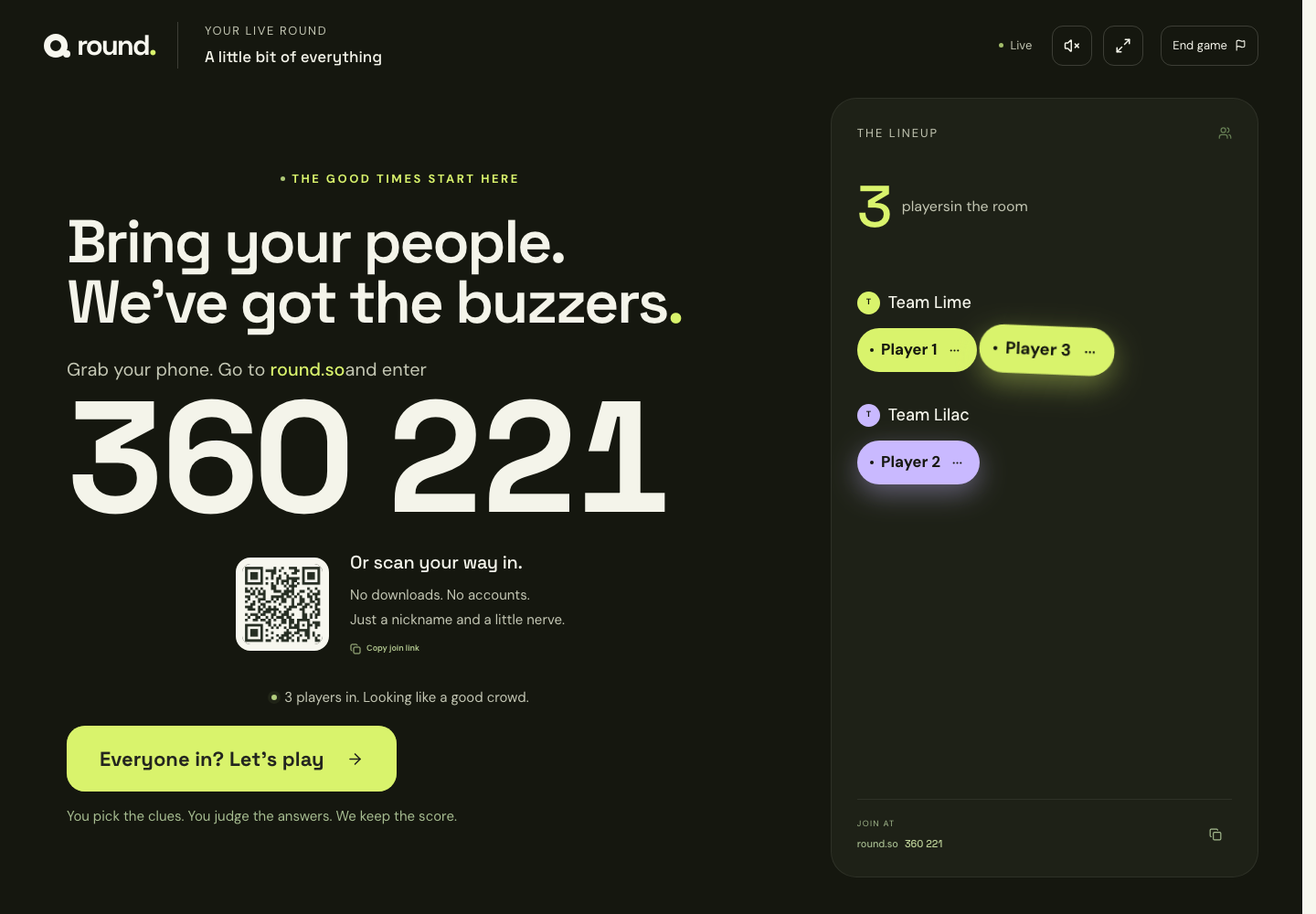
Read the code out loud as well as showing it. Someone will be looking at the chat and will miss the digits on the shared screen. Six digits, said once, slowly. Then leave the lobby up until the teams you expect are actually there. Starting with half the room still joining is how the first clue belongs to the two people who arrived early, and everyone else decides the game is not for them.
Categories a remote room can answer
You cannot point at the printer. You can still write about the work. The tool you all open. The meeting that happens standing nowhere. The phrase the team uses when a decision is actually done. A customer story that is allowed to travel. A city column if people want a break from the company. Keep the 100s generous. A person who has been quiet on calls for a year needs a point before you ask them to buzz on a 400, or they will stay muted in the way they always do, which was the problem you were hired to poke at, gently.
Write the answer first. Then a sentence you can say in one breath over a laptop microphone. If you stumble at your desk, the sentence is too long for a call. Put the other acceptable wordings on the card. You will not have the room’s faces to tell you that "standup" and "stand-up" were the same answer. The card is the face.
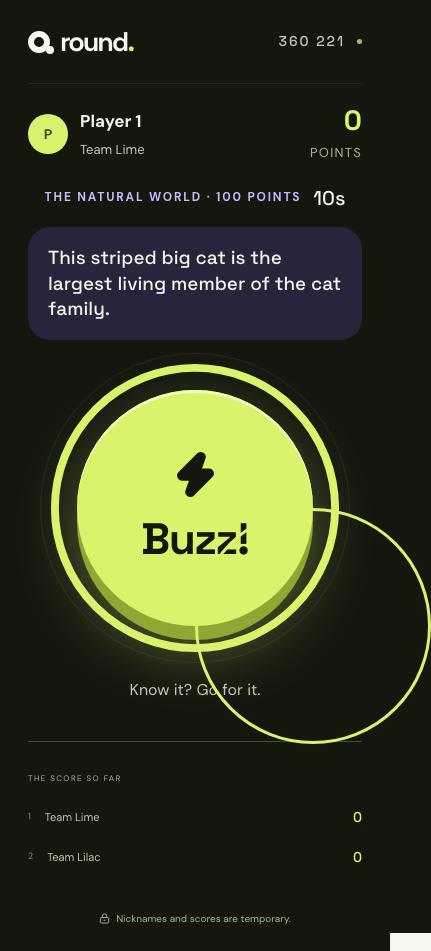
This is what they see. The clue, a clock, a button. They do not need the grid. You have the grid, on the screen you are sharing.
Rules that survive bad audio
Read the clue with buzzing closed, then open it. An early press waits a quarter of a second, so the person whose audio is ahead of the screen does not win by accident. Eight seconds to answer once they have buzzed. Ask them to unmute and speak. If they cannot, the team can type, but say that before you start, and stick to it. Inventing a text-answer rule on clue six is how a remote game becomes a thread.
A miss scores nothing. The score does not fall below zero. You are on a call with people’s names under their faces, or under a circle, and subtracting points feels louder there than it does in a bar. Ten seconds of nobody buzzing and you reveal the answer. Do not fill the silence. Silence on a call feels long. It is still only ten seconds, and filling it teaches them to wait for you.
If someone’s connection drops, their team keeps the phone that stayed. If the host’s share dies, you still have the clues in front of you and you can read them. The phones can keep buzzing. Say that at the start, casually, so a frozen screen is a nuisance and not the end of the hour.
Keep it to one board
Twenty-five to thirty-five minutes, plus joining. That is the meeting. A second board is a different invite, with a different title, on a different week. Remote groups are worse at leaving than groups in a room, because leaving is a button and someone always says "one more." You are allowed to be the person who says the round is over. "That’s sixteen. I’ll put the notes in the channel." Then stop sharing.
Do not add a reflection. The game was the conversation. A debrief about what the scores meant will talk the fun out of it, and the quiet people will feel graded. If you want them to talk, leave five minutes after you stop the share and ask one ordinary question, like what they are having for lunch. Then end the call on time. Ending on time is the team-building.
Questions that show up in the thread
Do virtual team building games work with cameras off?
Yes. The buzz does not need a face. A voice for the answer is enough, and a typed answer is enough if you said so before the first clue. Forcing cameras is how you lose the people who would have played.
What if we are in too many time zones for a long game?
Play twelve clues, or the whole sixteen, and publish the length in the invite. "Thirty minutes, then done" is a kinder promise than "a fun hour." The team in the late zone will come for a thing that ends. They will decline a thing that might become a hangout.
Can two offices play each other?
Yes. Each office is a team, or each office is two teams, and one host shares the board into the call. One phone per team, even if they are sitting together. The people in the room can see the shared screen on a television. The people elsewhere use the call. Same clues, same eight seconds.
What should the questions be about?
The work you share, told plainly, plus one column that is not the company so the hour is not a quiz about the handbook. Leave out anything a person would not want on a recording. Calls get recorded more often than living rooms do. Write as if the recording exists.
Share the screen, then give it back
Write the sixteen the day before. Read them into your own microphone once. Put the code in the chat and on the screen. Name the teams. Play one round. Stop sharing when the last answer is up. The call can end there, and it should.
A remote-shaped board is on the team building boards. Your own, from the work this team actually does, starts on the create page. The sentences, if you want them shorter, are in trivia night questions you can read out loud.
Host a team building round
One screen, sixteen clues, phones as the buzzers. The team building boards are already written, or start from a blank grid.