Hosting note
Christmas Games for the People Already in the Room
The coats are on the bed, the good plates are out, and someone has suggested a game in the tone of a person who will not be the one running it. Christmas games go wrong in a familiar way. Charades runs long. A trivia sheet from the internet asks about a movie half the room has not seen. A prize turns a nice hour sharp. The people who live here wanted to sit down together, and the game became a second job.
A better hour is one screen, one board, and the phones already in their pockets. Four categories. Sixteen clues, worth 100, 200, 300, and 400. You read the clue, you open the buzz, you decide who was right, and the score stays on the screen. Guests join with a six-digit code. No app and no account. They are not going to install something between the main course and the pudding, and you should not ask them to.
This is the house, not the office. The work version, the one that has to end because people have trains, is office holiday party games that end on time. A birthday in the same rooms is birthday party trivia the guest of honor can stand. Christmas is the year you all just lived, plus the people who only show up for it.
Play before the coats come back out
Decide the length while you are still setting the table. A full board runs somewhere around twenty-five to thirty-five minutes once buzzing makes sense. That fits after dinner and before anyone is looking at the door, if you start on time. It does not fit “while the pudding rests” unless you are only playing eight clues. Say which one it is. “We’ll do the top two rows” is a finished plan. “A quick game” is how you are still hosting when someone has their coat on.
Put the laptop where a sleeve will not drag the cable into the gravy. Stand at the far chair and read a clue before guests sit. If the fairy lights behind the screen make the type glow and disappear, move the lights, not the people. Guests will not tell you they cannot read the 400s. They will miss them and blame the questions.
The code stays up while people are still coming in from the kitchen. One phone per team. Teams of two or three, made before the grid appears, so you are not sorting marriages in front of an audience. Couples who live together can share if the night is gentle. Split them if you want the room louder. Say which one you are doing. A team of one will buzz faster than everyone and resent the game for rewarding speed. A team of six will elect a spokesperson and the rest will watch.
Free covers 20 people and 6 teams. That is a full house and the neighbors who always come. Night is $12 for 48 hours and 100 people. Host is $6 a month, or $48 for the year, and also covers 100 in a game. Players never pay. If the party is bigger than the room you paid for, play the people who can see the screen and let the hallway keep talking. The limits match the pricing page.
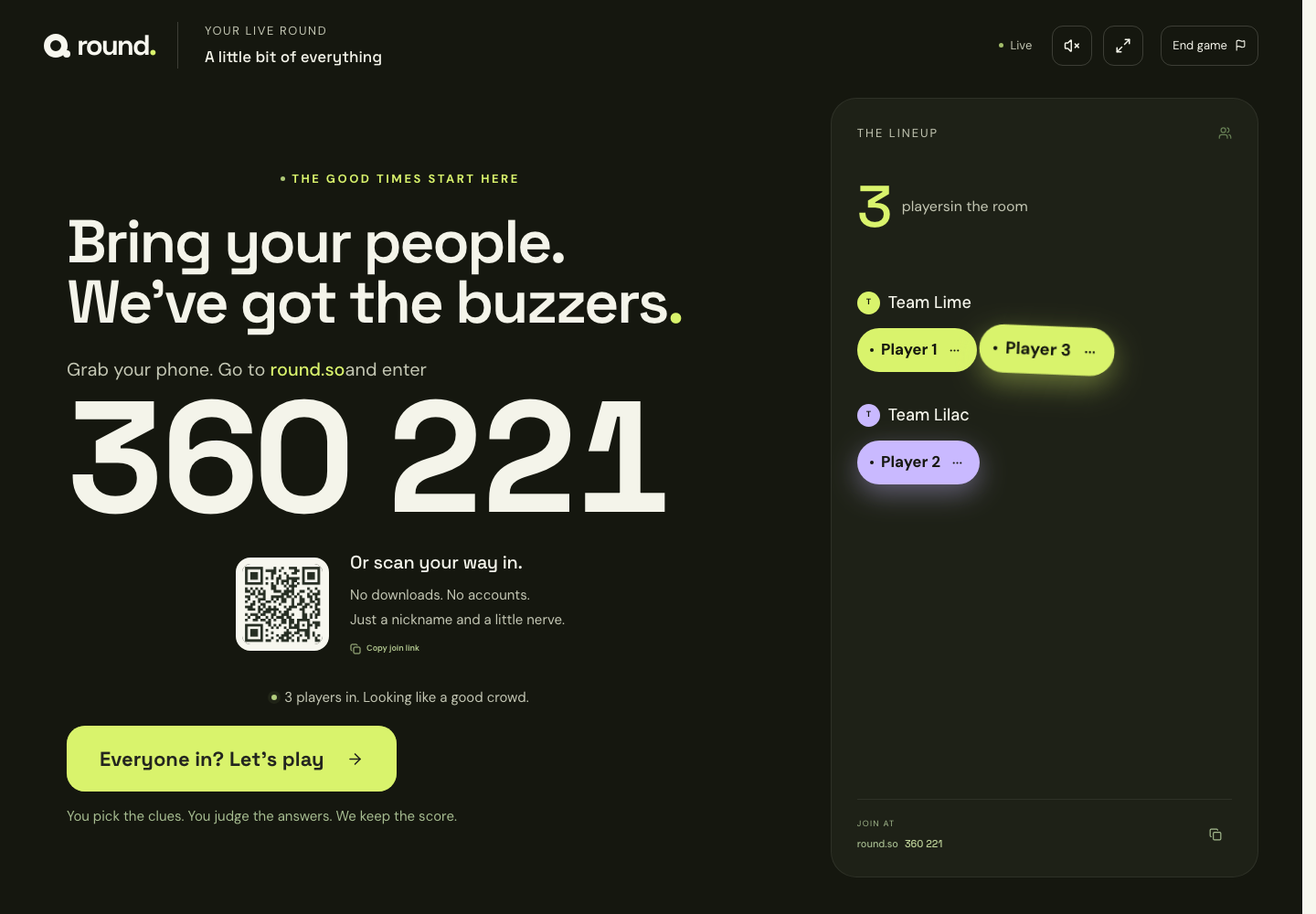
Leave this up. Teams appear as they join. You are not taking a register on the back of a cracker.
Categories from the year, not from a website
“Christmas trivia” from a search is a list of facts about films and historical trees. Your room did not gather to be quizzed on a film half of them slept through. The four columns can be the year you all lived, the people at the table, the food you actually cook, and one column that is easy enough for a guest who married in last spring.
The year column is the one that feels like Christmas without a costume. A 100 can be a thing that happened in the house: the month the trip was, the team someone supports, the show you finished and will not stop quoting. A 400 can be a detail only one person remembers, on purpose, so they get a moment and everyone else gets to groan. It should be a detail they like. The argument about the turkey is not a clue. The year someone would rather not narrate is not a clue. If you have to check whether it is kind, leave it off.
Food is safer than it sounds, and more local than a film round. The thing you burn every year. The dish that is not optional. The time you eat, if you are the kind of family that has a time. Write the answer the way people say it at this table, and write the other wording too. The formal name and the name the children use. You will hear both.
The people column is short on purpose. Names you can say. Jobs you can say. The city a cousin moved to, if they have already told the story twice tonight. Do not build a column out of absences. The person who could not come is not a punchline, and the person who came and wishes they had not is not a 400.
One column stays easy all the way down. Songs you all know. Animals. The town. A guest who sees this family once a year has to be able to score a 100 without studying your private history. If they cannot, the game is a reunion exercise for the insiders, and the guest will look at their phone, which is the thing you were trying to avoid.
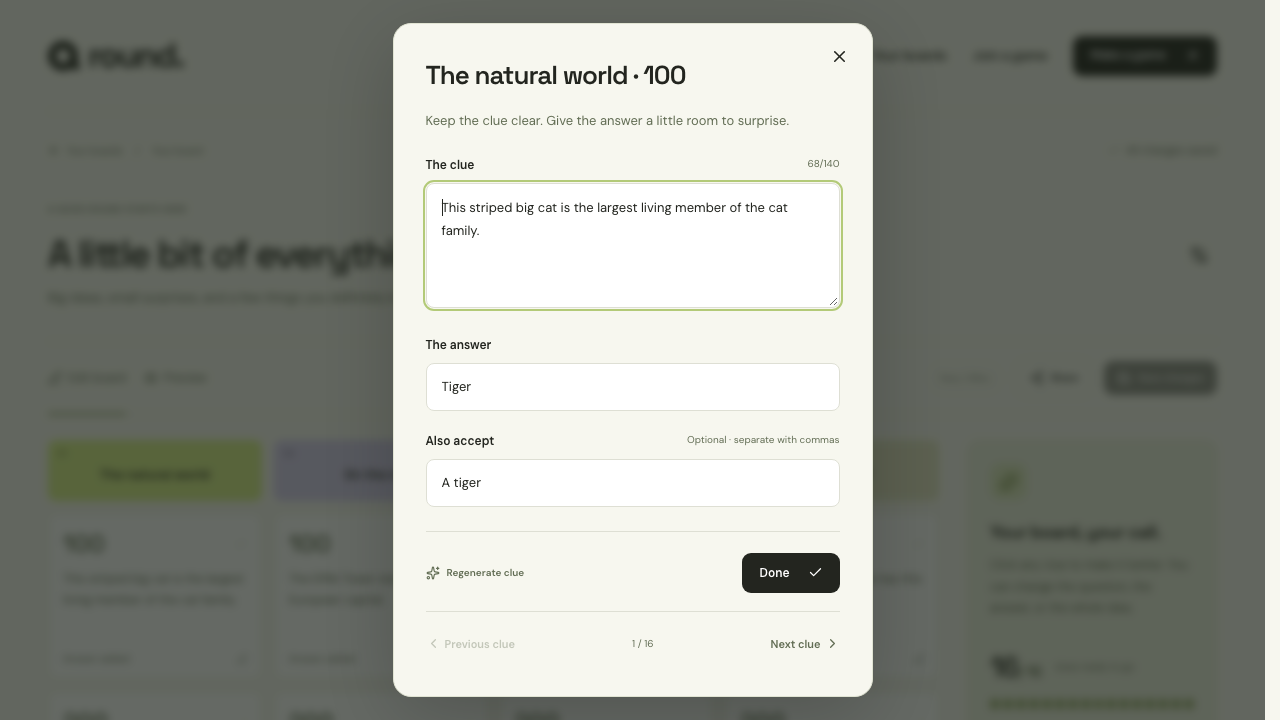
The card is the sentence you read, the answer you want, and the versions you will take. Do it before the first guest knocks. Judging from memory, with your uncle watching, is how a nice night gets a small argument between the pudding and the coats.
Rules you say once, over the crackers
You read the clue with buzzing closed. Then you open it. An early press waits a quarter of a second, so the person who mashes during the sentence does not win. Someone will test it, usually the relative who plays bar trivia and wants the room to know. Let the lockout do the explaining. You should not also make a speech about sportsmanship. It is Christmas. One demonstration is enough.
The team that buzzes clean gets eight seconds. You judge. The clock does not mark them wrong while you are still listening. At a party, a wrong answer costs the value of the tile. With kids buzzing, pick Kids on the way in so a miss scores nothing and the score cannot fall below zero. Friends and family keeps the sting, and that is the one for a table of adults. If a child is holding a buzzer, pick Kids. A deduction from a parent, in front of cousins, is not a joke they will remember the way you hope.
Ten seconds of nobody buzzing and you reveal the answer. Do not coax. Coaxing is how you lose the pudding window. After a right answer, that team picks the next tile. If one side of the family is running away with the night, hand a pick across the room. “Your pick, then one from the other end of the table.” People who have been sharing dishes all afternoon understand taking turns. You do not need a new points system invented over crackers.
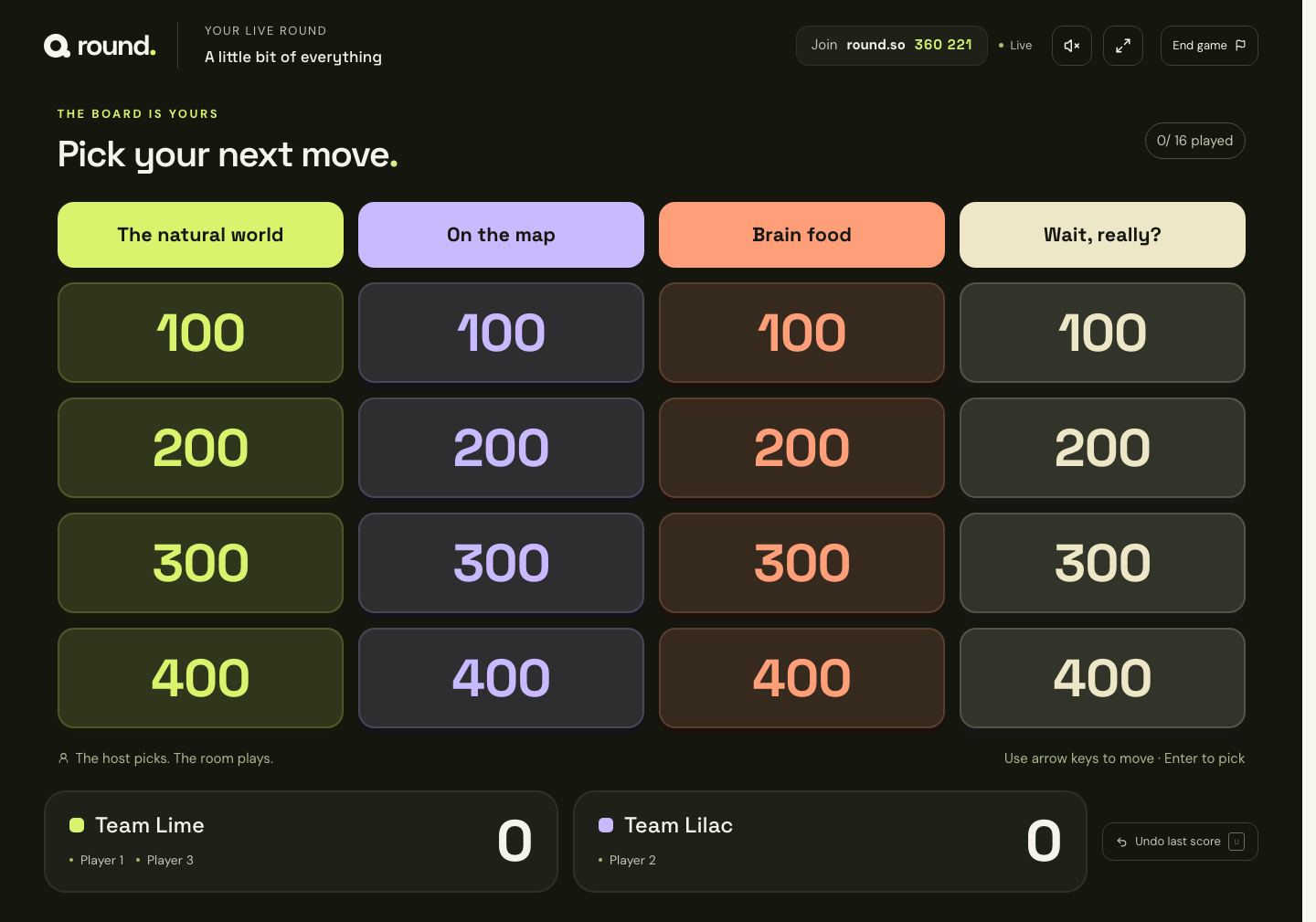
You run the grid from this screen. Their phones buzz. The score under the board is the one you will believe later, when someone claims they were robbed.
Children, visitors, and the person who knows every lyric
Children can play the easy column and a lot of the food column. They should not be quizzed on years from before they were born and then consoled in public. Put those clues on the adult column and let the adults have them. An adult holds the phone if the child is young. The child says the answer when they have one. That is a team, not a handicap.
Visitors get the easy column and the year, if the year was public. They do not get a speech about how the family works. If you catch yourself writing a clue that requires a preface, it is not a clue. It is a story for the kitchen, later, with fewer people.
The person who knows every lyric and every score will be delighted, and then they will be loud. Give them one column to sweep. Build the other three for the rest of the room. If they shout before a buzz, ignore it once, out loud. “We didn’t hear a buzz.” Then open it properly. You will hurt them a little. You will save the hour. Both are allowed, and you only do it once.
Do not let the game replace the one tradition people actually came for. If that tradition is a walk, a mass, a film, a particular toast, the board fits beside it, not on top of it. Sixteen clues after dinner. Or eight clues before the film. Not both, unless the room asks for the second board the way they ask for more food, which is with their mouths full and their coats still on the bed.
Prizes you will not regret in January
Name a winner. You do not need a prize that costs money. The last mince pie, choosing the film, a paper crown that was already going to be worn. A prize from a shop changes the way a family hears a close call, and Christmas is already full of close calls about other things. Keep this one cheap. If you want the night to raise money, that is a different plan, written up as a trivia night fundraiser, and it should be said in the invitation. A surprise collection bowl is not a game.
Stop when you said you would. If the pudding is ready, the pudding wins, even with a column still closed. Read the score, say the team name you can say in front of everyone, and close the laptop. A host who will not leave the screen has mistaken the game for the day. Take a photo if someone wants one, while the score is still up, and then help with the plates.
If the Wi-Fi in the house is the same Wi-Fi that fails every December when everyone is on it, have the backup in your head. First hand fully up, eight seconds, same answers. The television still shows the clue. The phones were only the buzzers. For one round you can be the referee. Pour someone else a drink while you do it, so you are not the only person working.
Questions people ask while they are setting the table
How long should Christmas party games last?
Eight clues if you are fitting them around food. Sixteen if you have a clear half hour and the screen is already working. Tell people which one when you suggest the game. A second board is a January night, not the twenty-fifth, unless the room refuses to let you turn it off.
Are Christmas games for adults different from family games?
The screen is the same. The columns change. Adults can take a harder year and the party sting, if you picked Friends and family. A table with children buzzing should pick Kids, so a miss does not take points, and the kids’ column has to be actually answerable. Do not run an adult quiz and then feel bad that the children left.
What if half the room has not seen the film?
Do not make the film a column. Make the year, the food, the people, and one easy subject you know they share. A guest should be able to score without having done homework. Christmas is a poor night for homework.
Do guests need to download anything?
No. A browser and the six-digit code. One phone per team. If a phone cannot load the page, that team points, and you take the first clear hand. Say so at the start.
The week before, not the afternoon of
Write the clues on a quiet night, from the people who are actually coming. Read them once in the kitchen. Cut any sentence you would not say with the visitor in the room. Get the cable out of the drawer that is not the television drawer. Christmas afternoon is too late to discover the adapter.
You can build the board from the Christmas boards, from a page of notes about the year, or from a blank grid on the create page. Pick Kids if children are buzzing. Pick Friends and family if the table is adults and a miss should cost the tile. Keep the board. Next December should not start from a blank page and a panic.
The sentences, if those are what stall you, are in trivia night questions you can read out loud. A Christmas clue is the same job as any other clue. One breath, an answer you have already accepted in more than one wording, and a stop time you mean.
Host a Christmas round
One screen, sixteen clues, phones as the buzzers. The Christmas boards are already written, or start from a blank grid.