Hosting note
Wedding Reception Games That Fit Between Courses
The kitchen is plating the next course and somebody’s uncle has already asked if there is going to be a game. You said yes in a group chat three weeks ago, because a speech felt heavier than a board, and now the room is full of people who have never met each other and have about the length of one seating to care. Wedding reception games work when they fit the gap you actually have, when every clue can be read in front of the couple, and when the tables that flew in yesterday can still score. They fail when you try to run a pub quiz through dinner, or when the 400s are stories only the wedding party was in the room for.
A wedding game, the way a living room can host it, is one screen everyone near it can see, one board of four categories and sixteen clues, and phones as buzzers. You read the clue. You open the buzz. You decide who was right. The score stays on the screen, so you are not keeping a napkin ledger between the fish and the cake. Players join with a six-digit code in the phone browser. They do not install an app and they do not make an account, which matters when half the room is a cousin you will not see until the next wedding and will not ask to download anything during a toast.
If the night is a birthday and the person in the crown is the subject, that plan is birthday party trivia the guest of honor can stand. If it is a Saturday on a couch with no cake to protect, start with how to host a trivia night at home. A reception is shorter than both of those want to be, and the food has a schedule you do not control.
The gap between courses is not a trivia night
Count the minutes you really have, standing in the venue on a weekday if they will let you, or on the phone with the person who does. A full board, once people understand buzzing, runs somewhere around twenty-five to thirty-five minutes. That is a course gap only if the kitchen is slow and the speeches are already done. It is too long if the band is waiting and the parents are watching the door to the patio. Tell the couple which one you are hosting when you promise the game, not when the plates are being cleared.
If the gap is ten minutes, do not pretend you will finish sixteen clues. Play the top two rows, the 100s and the 200s, eight clues, and stop when the food appears. Say that out loud at the start so a competitive table does not feel robbed when you close the board with tiles still shut. If the gap is a real half hour, seated, with the screen already up, play the whole board and do not add a second one. A second board is another night. This night has a first dance.
Put the laptop on a table that does not get bumped by the people carrying plates. The cable should already be in the screen before guests sit, because the minute you spend hunting for HDMI is a minute the room spends deciding the game was a mistake. Stand at the farthest chair that will play and read a clue. If you have to squint, the type is too small or the light behind the screen is winning. Fix it while the room is still in photos. Guests will not announce that they cannot read the 400s. They will miss them and then decide your questions were unfair.
Leave the join code up while people are finding their seats. The code is the instruction. You should not also be explaining the Wi-Fi, the rules, and where the bathrooms are in the same minute. If the venue Wi-Fi is the kind that asks for a password printed on a tent card, put that tent card next to the code, or tell tables to use their own data. A phone on a guest network that cannot load the page is a hosting problem you can see in the lobby, before you open the first tile.
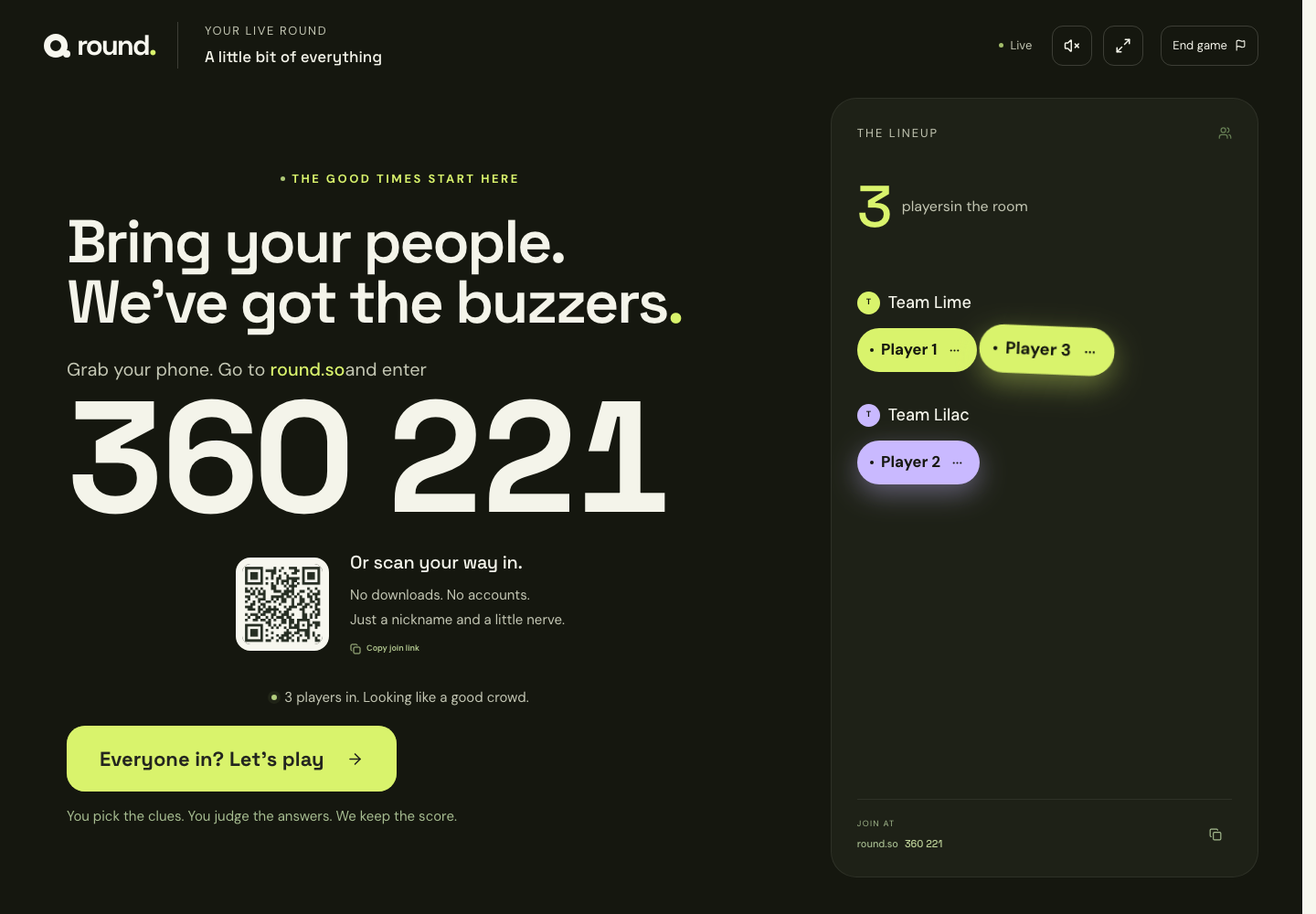
This is the screen you leave up. Teams appear as they join. You are not collecting names on a clipboard.
What the couple has already agreed to hear
Write the answers first, and only write answers the couple has told in public or handed you on purpose. The city they both name without hesitating. The song they picked, if the band is going to play it anyway. The job one of them had before this one, if that story is in the rehearsal dinner speech. A pet’s name, if the pet is in the photos on the table. A 100 should be easy for more than one table, or the first clue becomes a test of who has known them longest, and that contest has a winner you may not want at a wedding.
Ask them for eight facts the week before, in a message they can answer when they are not choosing flowers. Four of those facts should be things a guest from either family could know from the invitation, the website, or a story told at dinner. Four can be smaller, for the 300s and one 400, and they should still be facts the couple likes. “The first trip” is a gift if they light up. “The first trip” is a trap if the story ends with a person who is sitting at table six and was not invited to be a punchline.
Leave off anything you would not read with both mothers in the front row. Old relationships. Money. The fight about the seating chart. A joke about who was late to the proposal. If you have to check with a third person whether it is all right, it is not a clue. A surprise roast is not a surprise they consented to when they agreed to be married in front of these people.
The other table’s knowledge has to live on the board too. One column can be the couple. One can be the room: the city you are sitting in, the season, a year most of the guests actually lived. One can be simply easy, so a table of colleagues who met the couple last spring can get a point and stay in the game. One can be the wedding itself, and that column should be generous. The color of the flowers they can see. The hour on the invitation. The name of the room, if it is printed on the menu. Do not make guests study a program in order to deserve dessert.
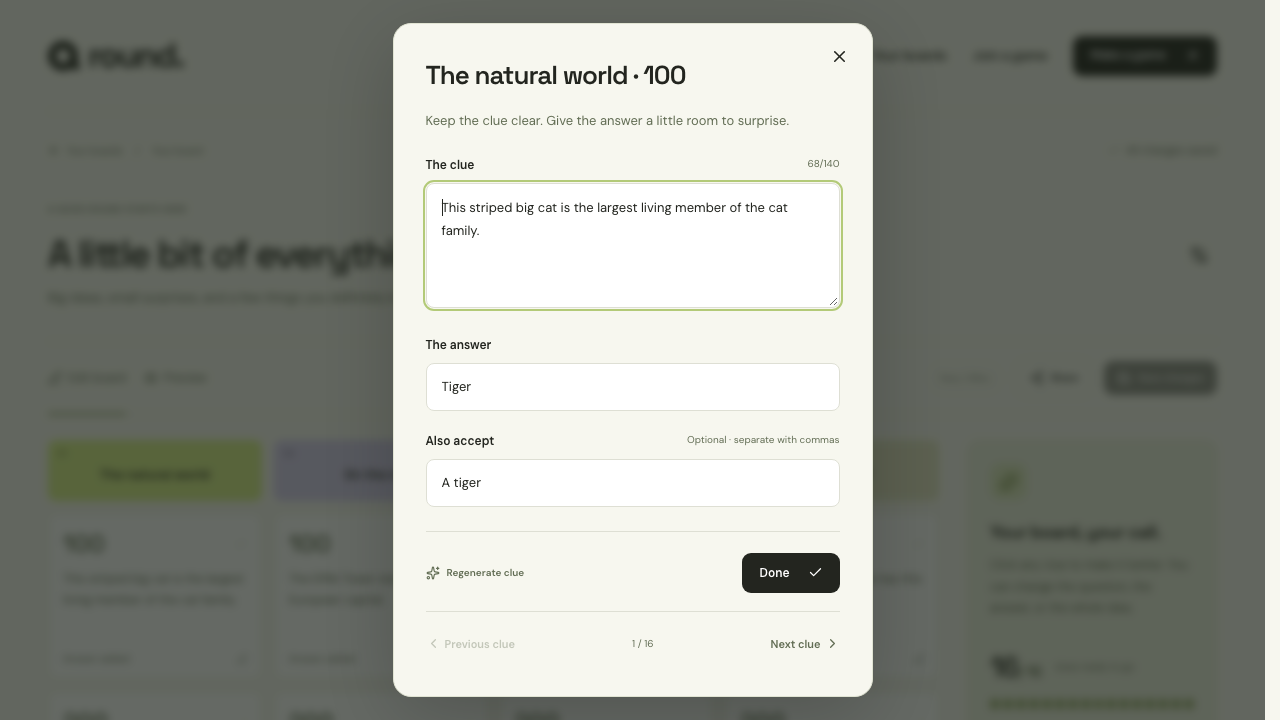
The card is the sentence you will read, the answer you want, and the other wording you will take without a speech. People will say the nickname and the proper name. They will say the city and the neighborhood. Write both down before anyone is watching your face. A wedding is a bad place to invent the rule while one family is winning.
How the tables play
Teams want to be the tables, or halves of tables, decided before the grid appears. Say it when you stand up, so nobody negotiates across a centerpiece. One phone per team, face up, brightness up. The person holding it is not the captain forever. Pass it after a few clues if the same hand keeps winning the race and the rest of the table has become a gallery.
Free covers 20 people and 6 teams. A Night pass is $12 for 48 hours and 100 people. Host is $6 a month, or $48 for the year, and also covers 100 people in a game. Players never pay. Night and Host raise the headcount. They do not raise the team cap, which stays at 6. If the reception is larger than 100 people, or you need more than 6 tables buzzing, do not promise the whole hall a buzzer. Play the tables that can see the screen and let the far side of the room keep talking. A game nobody can read is worse than no game. The prices and the limits are the same ones on the pricing page.
You read the clue with buzzing closed. Then you open it. A table that mashes the button while you are still talking does not win the race. That early press waits a quarter of a second after you open, which is enough to lose to the table that waited. Somebody will test this on clue one, usually a table that has played bar trivia and wants you to know it. Let them. The next clue will be calmer, and you will not have to repeat yourself over a centerpiece.
The first team that buzzes clean gets eight seconds. The clock is there so the room can see the time. It does not mark them wrong by itself. You do. At a party, a wrong answer costs the value of the tile. That sting is why a living-room round feels like a game, and it is also why a wedding can go sharp if the 100s are hard. Keep the top row easy enough that a deduction is rare. Do not switch the rule when a beloved uncle starts bargaining. If you blow a call, and you will, because you like these people, fix that one score where everyone can see it and keep going.
Ten seconds of nobody buzzing and the answer comes up. Do not coax. Coaxing feels generous and it teaches the room to wait you out, and then every clue takes four minutes and the kitchen is standing in the door. After a right answer, that team picks the next tile. Picking is the power. If one side of the room is running away with it and the other side has gone quiet, you can say, once, “Your pick, and then we’ll take one from the other side.” People understand. They came to a wedding, not a final.
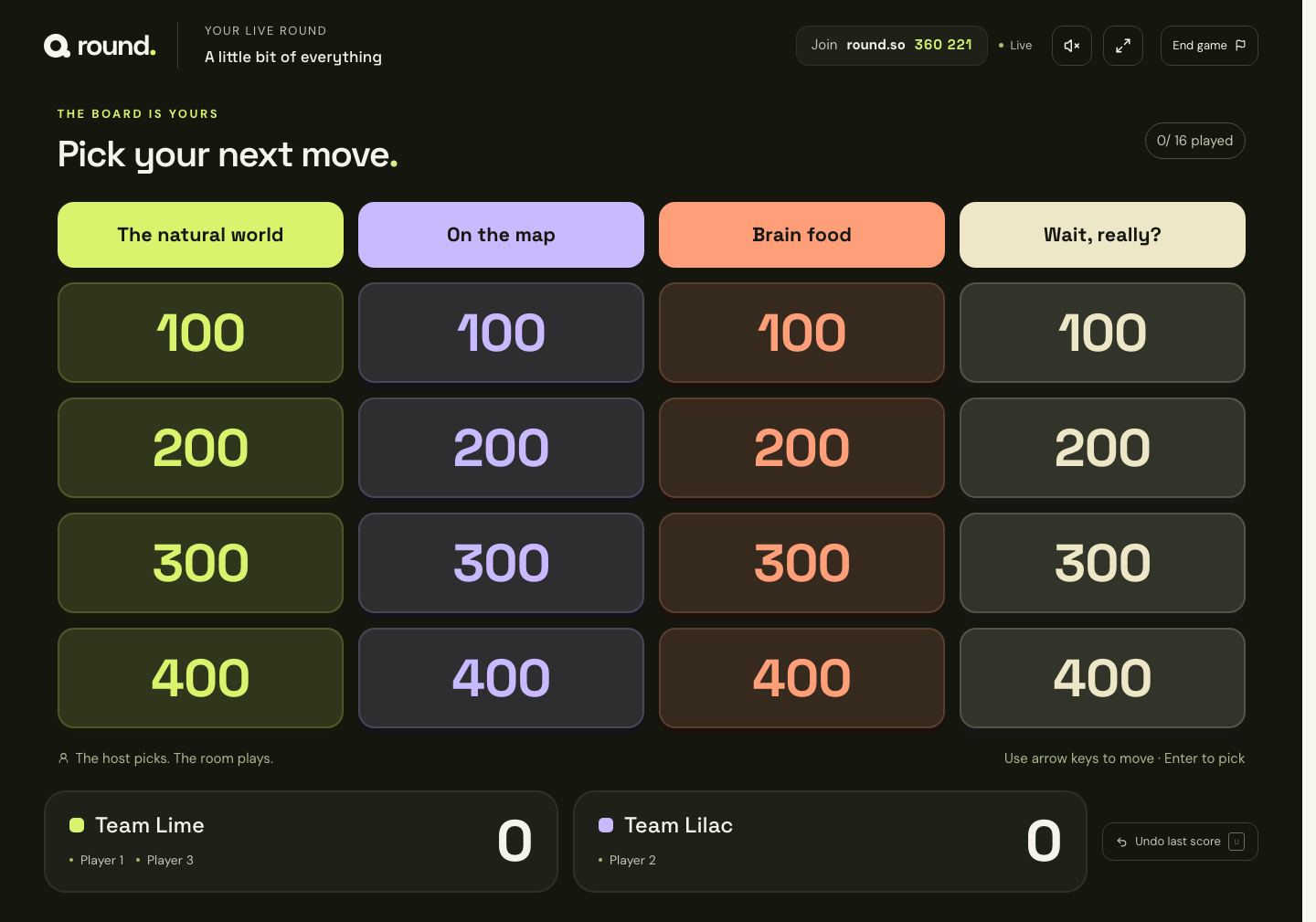
You pick from this screen, or you hand the pick to the team that just scored. Their phones are for buzzing, not for driving the grid. The score under the board updates without anyone adding on a menu card.
The table that knows everything, and the table that just landed
Every wedding has both. The table that has shared a group chat with the couple for a decade will be delighted, and then they will be a problem, because the table of college friends can hear the delight. Give that first table one column they will sweep, so they get to be brilliant, and three columns the rest of the room can live in. Do not build the board out of the group chat. The people who were not in it will check out by the third clue, and they will be right to.
The table that flew in yesterday needs a way to score that is not a mercy point. The easy column is that way, if the 100s are things in the room and the 200s are things from the last year a person could have learned from a toast. A 400 in the couple’s column can be a detail only one friend remembers, on purpose, so that friend gets a moment. It should still be a detail the couple likes hearing in public. If the detail requires a preface, it is a speech, and speeches have a different part of the night.
Children at the table change the volume, not the format. If kids are buzzing, consider the room before you start. Party scoring takes points away for a miss. A kids’ room does not. On the way in, the host chooses who is in the room. Friends and family keeps the party sting. Kids keeps a miss at zero and keeps the score from falling below zero. A wedding with a children’s table that wants to play is closer to the second. A wedding of adults who came to compete a little is the first. Pick it before the code goes up. Do not discover it when a nine-year-old loses 400 points and the table goes quiet.
Nicknames will be jokes. That is fine, as long as you can say them out loud when you award the points, and as long as they are names you would say with both families listening. If a team name arrives that you would not put on a place card, rename it before the first tile. You are the host. The screen is not a guest book.
Prizes, speeches, and the minute you stop
You need a winner, because people will ask. You do not need a prize that matters. Bragging rights, the first cut of cake handed to that table, a ridiculous object that goes home in a napkin. A prize worth real money changes the way a family hears a close call. This is not a fundraiser. Nobody paid to enter. The point of the board is the ten or thirty minutes when the tables were talking to each other instead of waiting for the next plate.
Stop when the food is ready, even if two columns are still closed. Say the score, name the table, and sit down. A host who will not leave the screen is a host who has mistaken the game for the wedding. If the couple wants a photo with the board, take it while the code is still up or while the final score is still on the screen, and then close it. The band does not need your laptop in the shot for the first dance.
Do not run the game over a speech. Do not run it over the cake. Do not run it from the dance floor with the screen behind a speaker. If the only gap left is three minutes, skip it. A promised game you cancel in one sentence is better than a game nobody can hear. You can say, “We’ll leave this one. The cake is the point.” The people who wanted the game will be briefly disappointed. The people who wanted dinner will be relieved, and both of those feelings are allowed at a wedding.
If you are also giving a toast, do not do both jobs in the same ten minutes. The toast is a paragraph you wrote. The game is a board you already checked. They ask for different voices. Give the toast, sit down, and let someone else advance the tiles if you are the one who might cry. You can still be the person who says whether the answer counted. You do not also have to be the person holding the laptop.
Questions people ask the week of the wedding
How long should wedding reception games last?
As long as the gap. Eight clues if the kitchen is moving. Sixteen if you have a real half hour and the screen is already working. A second board belongs to a different night, the one on the couch, not the one with a band waiting. Tell the couple the length when you offer to host, in minutes, not in “a quick game,” because quick means a different number to the person planning dinner.
Do guests need an app?
No. They join from the phone browser with the six-digit code on the screen. One phone per team is enough. They do not make an account. If a phone cannot load the page, that team can point, and you can take the first clear hand for that clue. Say that backup once, at the start, so it does not arrive as a crisis when the venue Wi-Fi folds.
What if the two families do not know the same stories?
Build one column for the couple, one for the room, one that is easy and in front of everyone, and one for a year or a place most guests share. The people who know the private history get a column to win. They do not get the whole board. A guest who met the couple last year should be able to score a 100 without studying.
Can you play if the reception is huge?
Play the tables that can see the screen. Free covers 20 people and 6 teams. Night and Host cover 100 people, and the team cap stays at 6. A hall larger than that is not one buzzer game, and it should not be promised as one. The far tables can keep their conversations. A game nobody can read will make the near tables look rude for playing.
Write it on a weeknight
Ask the couple for the eight facts. Write the sixteen clues, or the eight you will actually reach, with the other acceptable wording on the card. Read them out loud once, alone, in the kitchen at home. If you stumble, rewrite the sentence. Guests will hear it once, over a room that is also listening for their names.
Get the cable to the venue before the guests sit. Put the code up. Make the teams. Play the rows you have time for. Name a winner. Sit down before the next course.
You can build the board from the wedding boards, from notes the couple sent you, or from a blank grid on the create page. Pick Friends and family unless children are buzzing, in which case pick Kids so a miss does not take points away. The sample board is a decent way to learn the buzzers on a night when you do not want your own clues in front of both families yet. When you do want your own, keep them short enough to read between plates.
If the sentences themselves are the part you are stuck on, trivia night questions you can read out loud is the piece about writing a clue in one breath. A wedding does not need harder clues than a living room. It needs clues you can finish before the food comes back.
Host a wedding round
One screen, sixteen clues, phones as the buzzers. The wedding boards are already written, or start from a blank grid.